

From Speech Acts to Digital Action: Extending Austin’s Theory in the Technological Era
Introduction – The Rise of Human–Technology Communication
1.1 Overview of Human Communication Evolution
Communication is the lifeblood of human civilization. From primitive gestures and cave inscriptions to the complex, multimodal exchanges of the digital era, humanity has relied on communication not only to transmit information but also to create social order, express identity, and perform action. The story of communication is, therefore, the story of human evolution — an ongoing dialogue between human cognition, society, and technology.
In the earliest societies, communication was oral and communal. Meaning was constructed within shared contexts — through tone, rhythm, and ritual. Words were performative in nature, often linked to spiritual or social functions. A spoken blessing, curse, or oath was understood to carry real force. This performative essence of language prefigured what philosophers would later formalize in linguistic theories.
The invention of writing systems marked a profound shift: communication became recorded and transferable beyond immediate presence. The written word allowed ideas to travel through time and space, creating civilizations built upon preserved thought. However, this also began to separate the act of communication from the physical presence of the communicator — an early precursor to today’s digitally mediated world.
The print revolution of the fifteenth century, followed by the industrial and electronic ages, democratized access to knowledge. Newspapers, radio, and television redefined the scale of communication, extending one voice to millions. Yet, even in these forms, communication remained fundamentally human-centered — requiring intentionality, authorship, and human understanding.
It was not until the digital revolution that the nature of communication itself began to transcend traditional human boundaries. The emergence of the internet, artificial intelligence, and social media platforms has introduced a new communicative ecosystem where meaning is co-created between humans and non-human agents. Here, messages are no longer purely linguistic; they are algorithmic, symbolic, and interactive. A “like,” an emoji, or an automated chatbot response can perform social and emotional functions once reserved for human speech.
Philosophically, this development compels us to revisit the foundations laid by J.L. Austin (1962) and John Searle (1969). Austin’s Speech Act Theory proposed that language does not merely describe reality but actively brings it into being. To say “I apologize” or “I name this ship” is to perform an act, not to report one. Language, therefore, is not only expressive but operative.
However, in the 21st century, the agent of performance has multiplied. Today, a digital assistant like Siri or ChatGPT can perform an action in response to linguistic input — ordering food, composing messages, or interpreting emotional tone. Similarly, algorithms determine what content users see, shaping collective opinions and behaviors without direct human intent. The question thus arises: can these technologically mediated actions be considered genuine communicative acts?
This is the central inquiry that motivates the emergence of Digital Action Theory (DAT). DAT builds upon the philosophical foundation of Austin’s Speech Act Theory but extends it to account for the fusion of human intention and machine mediation. It recognizes that in the digital age, communication is no longer confined to verbal utterances; it encompasses coded signals, data flows, and algorithmic feedback loops that act upon the world and its users.
In this context, human communication has evolved from being interpersonal to interfacial — occurring not just between people, but between people and intelligent systems. The boundary between speaker and medium has blurred; a tweet, a chatbot response, or a viral video can initiate actions with real-world consequences, independent of the original author’s presence.
Therefore, the study of communication today requires a redefinition of key philosophical categories:
- Speech is no longer limited to words but extends to symbolic digital expression.
- Action is no longer purely human but includes algorithmic intervention.
- Intention is not always conscious; it may emerge from coded systems trained to simulate human reasoning.
The rise of human–technology communication is not merely a technological event but an ontological shift — one that challenges our understanding of what it means to speak, act, and be heard. As such, Digital Action Theory proposes to reinterpret communicative action through the lens of digital agency — where meaning is collaboratively produced by humans, machines, and the networks that connect them.
Synthesis: From Human Expression to Digital Action
The transformation of communication from oral expression to digital interaction represents more than just technological progress — it is a redefinition of agency and intentionality in human action. In traditional speech act theory, every communicative act was anchored in a human speaker’s will and consciousness; meaning was generated through intentional performance. However, in the digital age, action often emerges through distributed agency, where algorithms, data systems, and artificial intelligence share in the performance of meaning-making.
A simple notification, automated recommendation, or digital transaction is not merely a transmission of data; it is an act that affects behavior, shapes emotion, and alters social reality. The “performative” has moved from the individual speaker to the networked environment, where words, images, and algorithms co-operate to produce outcomes. In this expanded field, communication itself becomes a system of actions — both human and non-human — intertwined in real time.
Thus, Digital Action Theory (DAT) emerges as a necessary intellectual evolution — a bridge between Austin’s performative linguistics and the algorithmic realities of the 21st century. It acknowledges that communication has evolved into a hybrid domain where code can perform acts, interfaces can express intent, and artificial systems can emulate dialogue. This new paradigm demands that scholars, technologists, and philosophers rethink what it means to do things with words when words themselves are generated, mediated, and acted upon by machines.
In the next section, we delve into theoretical reexamination of Speech Act Theory to identify the enduring principles that can support its transformation into the Digital Action Theory framework.
1.2 The Role of Digital Platforms and AI in Shaping Interactions
In the 21st century, digital platforms and artificial intelligence (AI) have emerged as dominant mediators of human interaction. Unlike traditional forms of communication — which were bounded by time, space, and the physical presence of speakers — digital environments create continuous, algorithmically mediated exchanges. These systems reshape how people speak, listen, and act by embedding communication within data-driven architectures.
1.2.1 Digital Platforms as Social Ecosystems
Platforms such as Facebook, X (formerly Twitter), TikTok, YouTube, and WhatsApp have evolved into complex social ecosystems rather than mere tools. They govern what content is visible, how users engage, and what emotional or social responses are encouraged. Each interaction — a like, share, or comment — becomes a micro-action that contributes to collective meaning-making. Through algorithms, these platforms curate attention, rewarding certain linguistic or visual patterns while suppressing others.
Thus, communication is not only about what is said, but also about what the system allows or amplifies. Meaning becomes algorithmically filtered and socially constructed.
1.2.2 Artificial Intelligence as an Interactive Agent
Artificial intelligence now performs communicative roles once reserved for humans: writing, translating, recommending, teaching, and even consoling. Systems like ChatGPT, digital assistants, and generative media engines demonstrate that machines can participate in performative acts — responding, persuading, and shaping discourse outcomes.
This development challenges traditional notions of agency: if AI systems can simulate or even influence human responses, then the boundary between speaker and tool blurs. In this environment, communication becomes co-produced between human intention and machine design.
1.2.3 Algorithmic Power and the Reconfiguration of Agency
The power of digital platforms lies in their invisible algorithms — sets of coded instructions that determine what users see and how they behave. These systems do not merely reflect human communication; they direct it. The structure of algorithms transforms speech into quantifiable data, and data into behavioral prediction. As a result, speech acts are redefined as data acts — each message contributing to an economy of surveillance, marketing, and influence.
This shift introduces a new form of digital illocution — where the intent of communication is partially embedded in the design of the platform itself. For example, a social media post does not only express an idea; it triggers algorithmic responses that decide its reach and emotional impact. Meaning, therefore, is not static but co-constructed between users and machines.
1.2.4 Emotional and Cognitive Implications
AI-driven environments have also reshaped emotional and cognitive dimensions of communication. Constant notifications, personalized feeds, and digital companionships influence how humans experience presence, empathy, and belonging. The once private act of speech is now a public data event, archived and analyzed across networks.
This produces new emotional realities — from digital empathy to algorithmic anxiety — revealing that communication is no longer only linguistic but psychotechnological.
1.2.5 Toward a Digital Ecology of Interaction
Understanding communication in this new environment requires a digital ecological perspective — one that situates human interaction within systems of algorithms, platforms, and AI-driven feedback loops. Communication is no longer linear but cyclical, automated, and participatory. Digital platforms and AI do not just facilitate communication; they perform it, continuously generating new layers of meaning and consequence.
1.3 Problem Statement: Can Speech Act Theory Still Explain Modern Communication?
When J. L. Austin introduced Speech Act Theory in the mid-20th century, his central claim — that to say something is to do something — revolutionized the philosophy of language. Austin’s model, further refined by John Searle, emphasized that human communication is not limited to the transfer of information but includes performative actions such as promising, ordering, declaring, or apologizing. In this framework, language is understood as a tool of intentional human agency.
However, the digital revolution has radically transformed the conditions of performativity. Today, communication unfolds within algorithmic systems that mediate, modify, and even initiate acts of meaning. Messages are no longer simply uttered and received; they are processed, filtered, and amplified by artificial agents. Consequently, Austin’s original model — grounded in face-to-face interaction — struggles to account for non-human participation in communicative acts.
1.3.1 The Limits of Classical Speech Act Theory
Classical Speech Act Theory assumes several key premises that the digital age disrupts:
- Human-Centered Agency – Austin’s framework presupposes that all performative acts originate from a conscious speaker. Yet in the digital sphere, actions often emerge from algorithms, bots, or automated systems that simulate intentionality without consciousness.
- Stable Context – Traditional communication assumes a shared physical or temporal context. Digital interactions, however, occur in asynchronous, multi-layered environments, where one message can persist indefinitely and trigger new actions long after its creation.
- Direct Interaction – Speech Act Theory focuses on the speaker–hearer relationship. Digital communication introduces mediated and multi-agent interactions, where third-party systems (such as AI, servers, or platforms) influence meaning and consequence.
- Transparency of Intent – In Austin’s model, the speaker’s intent is the core of performativity. In contrast, digital communication embeds hidden or coded intentions — those of corporations, algorithms, or data-driven systems — that shape outcomes invisibly.
These transformations indicate that the performative power of language has expanded beyond human control. Words, images, and data now operate within hybrid systems where meaning is dynamically co-created by human and non-human agents.
1.3.2 The Need for Theoretical Renewal
Given these changes, the pressing question arises: Can Speech Act Theory, in its classical form, still describe and explain communication in the digital era? The answer appears to be partially, but insufficiently. While Austin’s insight into language as action remains foundational, it must evolve to accommodate the digital turn — the age in which actions are coded, automated, and globally networked.
Digital communication demands a theoretical framework that recognizes:
- The performative role of algorithms;
- The distributed nature of agency between humans and machines;
- The datafication of speech acts as quantifiable events; and
- The ethical implications of automated meaning-making.
This recognition forms the intellectual foundation of Digital Action Theory (DAT) — an expanded model of performativity that integrates human intention, technological mediation, and algorithmic agency into one comprehensive framework.
1.3.3 Toward a New Paradigm
The emergence of Digital Action Theory is therefore not a rejection of Austin but a continuation of his insight under new conditions. As the 21st century witnesses the rise of machine communication, synthetic voices, and automated persuasion, scholars must redefine what it means to “do things with words” when words themselves are partly generated and performed by machines.
1.4 Purpose, Scope, and Relevance of a New Theory
The central purpose of this book is to propose and elaborate Digital Action Theory (DAT) — a framework that extends classical Speech Act Theory into the digital age. DAT seeks to explain how human and non-human agents co-produce meaning, perform actions, and influence social, political, and cultural outcomes in technologically mediated environments. By situating speech acts within the context of digital platforms, artificial intelligence, and algorithmic mediation, DAT aims to offer both theoretical rigor and practical insight for understanding contemporary communication.
1.4.1 Purpose of Digital Action Theory
The primary purposes of DAT can be summarized as follows:
- To Reinterpret Performativity in Digital Spaces – Whereas classical speech act theory emphasizes human intention in face-to-face communication, DAT investigates how digital tools, AI, and platforms themselves participate in performative acts, creating hybrid forms of action.
- To Account for Distributed Agency – DAT emphasizes that agency in digital communication is often shared between humans and machines, challenging traditional notions of the speaker, listener, and context.
- To Bridge Theory and Practice – By connecting philosophical insights with practical analysis of digital interactions, DAT provides scholars, developers, and policymakers with a framework to understand how technology shapes behavior, discourse, and societal norms.
1.4.2 Scope of the Theory
DAT covers a broad yet focused spectrum of communication phenomena, including:
- Algorithmically mediated speech acts – notifications, automated responses, and recommendation systems.
- Human–machine interaction – chatbots, digital assistants, and AI-generated content.
- Social platform dynamics – virality, engagement metrics, and the role of algorithmic amplification in shaping perception.
- Cross-modal communication – emojis, memes, digital gestures, and other non-linguistic symbolic forms.
By examining these areas, DAT situates itself at the intersection of linguistics, philosophy, communication studies, and technology studies.
1.4.3 Relevance in Contemporary Contexts
The relevance of Digital Action Theory is increasingly apparent as digital communication becomes the primary mode of social interaction worldwide. Its application has implications in multiple domains:
- Education and E-Learning – Understanding how AI tutors, chat platforms, and digital classrooms facilitate or hinder performative learning acts.
- Politics and Social Movements – Analyzing how tweets, viral campaigns, and automated bots can influence political discourse and mobilize collective action.
- Media and Journalism – Interpreting how algorithmic curation and AI-generated content transform reporting and audience engagement.
- Ethics and Governance – Informing policy regarding AI-mediated communication, misinformation, and the social impact of automated speech.
Chapter 2: Speech Act Theory Revisited
In this chapter, we revisit the foundations of Speech Act Theory (SAT) as proposed by J. L. Austin and later refined by John Searle. The goal is to analyze its key tenets, understand its traditional applications, and critically examine why digital interactions require theoretical expansion. This sets the stage for the development of Digital Action Theory (DAT)
2.1 Key Tenets of Austin’s Theory
J. L. Austin’s Speech Act Theory (SAT) fundamentally transformed our understanding of language by asserting that speaking is doing — that is, utterances do not merely describe reality but perform actions. Austin categorized speech acts into three core tenets, each representing a different aspect of how language functions as action.
2.1.1 Locutionary Acts
Definition:
A locutionary act is the act of saying something, encompassing the utterance’s phonetic, grammatical, and semantic properties. It is concerned with the literal content of the message.
Fresh Examples:
- “The meeting starts at 10 a.m.” → Literally communicates the scheduled time.
- “Water boils at 100°C.” → Conveys a scientific fact.
- “I am feeling tired today.” → Expresses the speaker’s state of being.
Key Features:
- Focuses on the literal meaning of words.
- Constitutes the foundation for further performative acts (illocution and perlocution).
- Requires shared understanding of language and symbols.
2.1.2 Illocutionary Acts
Definition:
An illocutionary act represents the intended function of the utterance — what the speaker aims to accomplish in saying it. Illocution reflects the performative intention behind speech.
Fresh Examples:
- “Please submit the report by Friday.” → Issuing a polite directive/request
- “Congratulations on your promotion!” → Expressing praise
- “I hereby declare this meeting open.” → Performing a formal declaration
Key Features:
- Depends on the speaker’s intention.
- Can be performative, assertive, directive, commissive, or expressive (following later refinements by Searle).
- Realized when uttered correctly according to social norms and context.
2.1.3 Perlocutionary Acts
Definition:
Perlocutionary acts are the effects or outcomes produced by the utterance on the listener. They include responses, reactions, or changes in behavior and emotion, whether intended or unintended by the speaker.
Fresh Examples:
- “Don’t touch that wire, it’s live!” → Listener becomes cautious or alarmed
- “You have done a great job presenting.” → Listener feels motivated or proud
- “The deadline is tomorrow.” → Listener hurries to complete the task
Key Features:
- Concerned with the impact of speech on others.
- Often dependent on context, perception, and interpretation by the listener.
- Extends the performative force of language beyond the act of speaking.
2.1.4 Summary of the Three Tenets
| Tenet | Focus | Example |
|---|---|---|
| Locution | Literal content of the utterance | “Water boils at 100°C” |
| Illocution | Speaker’s intended function | “Please submit the report by Friday” |
| Perlocution | Effect on the listener | Listener hurries to meet the deadline |
2.2 Traditional Human-Centered Examples
Before the digital era, speech acts were mostly human-centered, context-dependent, and face-to-face. Understanding them in traditional settings helps us appreciate the transformations that digital interactions bring.
2.2.1 Locutionary Acts in Face-to-Face Contexts
In traditional interactions, locutionary acts involve spoken words with literal meaning, often shaped by tone, gesture, and immediate social context.
Examples:
- A teacher saying, “The exam starts at 9 a.m.” → Clearly conveys information to students.
- A friend saying, “I’m exhausted after the hike.” → Expresses personal state and experience.
- A scientist saying, “This chemical reacts with water.” → Communicates factual content in a lab setting.
Key Points:
- The meaning is explicit and immediate.
- Context (location, relationship, timing) strongly influences interpretation.
- Listeners rely on shared understanding of language and situation.
2.2.2 Illocutionary Acts in Face-to-Face Contexts
Illocutionary acts involve speaker intentions and performative functions that go beyond literal words.
Examples:
- A manager saying, “Please submit the report by 5 p.m.” → Performs a request
- A friend saying, “I promise to support you at the competition” → Performs a commitment
- A judge saying, “I hereby declare the court in session” → Performs a formal declaration
Key Points:
- Illocutionary acts require shared social conventions.
- Success depends on recognition by listeners.
- Intention matters more than literal phrasing; for instance, politeness or authority can shape the act.
2.2.3 Perlocutionary Acts in Face-to-Face Contexts
Perlocutionary acts are concerned with effects or outcomes that the utterance has on the listener.
Examples:
- A parent saying, “Finish your homework now!” → Child hurries to complete it.
- A speaker saying, “You did well in your presentation!” → Listener feels motivated or proud.
- A doctor saying, “This medicine may cause drowsiness.” → Patient becomes cautious and attentive.
Key Points:
- The effect may be intended or unintended.
- Perlocution relies heavily on the listener’s perception, emotions, and situational awareness.
- Face-to-face cues like tone, gestures, and eye contact enhance the perlocutionary impact.
2.2.4 Summary
| Tenet | Traditional Human Example |
|---|---|
| Locution | Teacher: “The exam starts at 9 a.m.” |
| Illocution | Manager: “Please submit the report by 5 p.m.” |
| Perlocution | Parent: “Finish your homework now!” |
2.3 Critiques of Speech Act Theory
While Austin’s theory revolutionized the understanding of language as action, scholars have pointed out several limitations, especially when considering broader, modern communication contexts.
2.3.1 Context-Bound Limitations
Critique:
- Austin’s framework heavily relies on shared social norms and immediate context.
- Speech acts are assumed to be interpretable only when participants share the same cultural, social, and linguistic background.
Implication:
- In multicultural or technologically mediated interactions, meaning can be misinterpreted, as the required context may be absent or partial.
Example:
- Saying “I’ll see you soon” in a face-to-face context carries a clear social expectation. Online, in a chat or email, the exact timeframe may be ambiguous, leading to confusion.
2.3.2 Linear Structure of Interaction
Critique:
- Austin assumed a linear, sequential model: speaker utters → listener interprets → act is completed.
- Real-world interactions are often simultaneous, overlapping, and multi-layered.
Implication:
- Modern communication, particularly group discussions, online forums, and social media threads, rarely follow a neat linear flow.
- Speech acts may occur in parallel or asynchronously, making Austin’s linear model insufficient.
2.3.3 Face-to-Face Orientation
Critique:
- SAT was developed with direct, face-to-face interaction in mind, assuming that gestures, tone, and immediate feedback are available.
- Digital communication often removes these cues, which changes both the interpretation and performative force of speech acts.
Example:
- A sarcastic comment in person can be recognized through tone and facial expression.
- In a text message or tweet, the same words may be misunderstood, showing the limits of SAT in non-physical contexts.
2.3.4 Summary of Critiques
| Critique | Explanation |
|---|---|
| Context-Bound | Requires shared norms; online contexts may lack this. |
| Linear Structure | Assumes sequential interaction; digital interactions are often asynchronous. |
| Face-to-Face Orientation | Relies on physical cues; digital communication removes them. |
2.4 Why Digital Interactions Challenge Austin’s Tenets
The classical Speech Act Theory (SAT) assumes that language acts are performed in immediate, face-to-face contexts, with shared social norms, linear exchanges, and observable cues. The digital era, however, introduces conditions that disrupt these assumptions, creating new dynamics for human communication.
2.4.1 Asynchronous Communication
Challenge:
- Digital platforms such as email, forums, and social media allow messages to be sent and received at different times, breaking the linear flow of traditional speech acts.
Example:
- A tweet or comment may be responded to hours or days later, meaning the perlocutionary effect can be delayed or altered by intervening events.
- Traditional SAT assumes immediate feedback, which no longer always occurs.
2.4.2 Lack of Physical and Social Cues
Challenge:
- Text-based digital communication often lacks tone, facial expressions, and gestures.
- Illocutionary acts (speaker intent) become harder to interpret, and perlocutionary effects (listener reactions) may be misread or muted.
Example:
- A sarcastic comment on WhatsApp can be interpreted literally, potentially causing misunderstanding.
- Emojis, GIFs, or formatting are attempts to compensate for the missing face-to-face cues.
2.4.3 Expanded Audiences and Contexts
Challenge:
- Online communication is often public or semi-public, reaching diverse audiences with varied cultural, linguistic, and social backgrounds.
- Locutionary meaning may be stable, but illocutionary intentions may not be universally recognized, and perlocutionary effects can vary widely.
Example:
- A Facebook post intended as a joke may be received as offensive by different communities.
- The shared social norms assumed in SAT are fragmented in digital spaces.
2.4.4 Multi-Modal and Platform-Specific Interaction
Challenge:
- Digital communication is multi-modal, combining text, video, audio, emojis, and interactive elements.
- Each mode contributes differently to locution, illocution, and perlocution, complicating Austin’s simple categorization.
Example:
- A live-streamed announcement blends speech, visual cues, and chat reactions.
- Understanding the speech act requires integrating multiple streams of information, not just the words themselves.
2.4.5 Summary of Digital Challenges
| Aspect | Challenge to SAT |
|---|---|
| Asynchronous Communication | Breaks linear flow; delayed feedback alters perlocutionary effects |
| Missing Physical Cues | Difficult to interpret illocution; sarcasm, tone, gestures absent |
| Expanded & Diverse Audiences | Shared social norms fragmented; reactions vary widely |
| Multi-Modal Platforms | Speech acts now combine text, visuals, audio, and interactivity |
2.5 From Speech Acts to Digital Action Theory
The challenges presented by digital communication — asynchronous interactions, missing physical cues, diverse audiences, and multi-modal platforms — highlight the need for a modernized framework. Digital Action Theory (DAT) emerges as a response, retaining Austin’s insights while adapting them to the technologically mediated environment.
2.5.1 Core Idea of Digital Action Theory
Definition:
Digital Action Theory posits that human agency in digital spaces is enacted through speech, text, and multi-modal actions, mediated by platforms, algorithms, and networked audiences. In other words, digital actions are performative acts shaped by technology.
Key Points:
- Agency persists: Humans remain actors who intend, interpret, and respond.
- Platforms mediate speech acts: Social media, messaging apps, and AI interfaces influence how actions are performed and received.
- Multi-layered effects: Perlocutionary effects are amplified, delayed, or transformed through digital networks.
- Context is dynamic: Online contexts are fluid, with diverse and often global audiences.
2.5.2 Digital Locution, Illocution, and Perlocution
DAT reframes Austin’s three tenets to fit digital communication:
| Austin’s Tenet | Digital Interpretation | Example |
|---|---|---|
| Locution | Words, text, video, audio, emojis that convey content | A Zoom chat message: “The meeting starts at 3 p.m.” |
| Illocution | Intent behind digital message, shaped by platform features | Slack message: “Please review the document” → directive performed via workspace norms |
| Perlocution | Reactions and outcomes mediated by audience size, algorithmic visibility, and timing | Tweet gets retweeted, liked, or debated → influence spreads globally |
Key Difference:
- In digital contexts, actions are not only human-driven — platform design, AI, and network effects become part of the performative act.
2.5.3 Examples of Digital Action in Practice
- Professional Communication:
- Email: “Please submit your report by Friday.”
- Effects: Automated reminders, shared calendars, and project management apps extend the perlocutionary impact.
- Social Media Interaction:
- Instagram post: “We’re launching a new campaign today!”
- Effects: Likes, shares, comments, and algorithmic boosting amplify perlocution.
- AI-Mediated Interaction:
- ChatGPT response to a user query
- Effects: Human interpretation and response combine with AI-mediated delivery, creating a hybrid locution/illocution/perlocution act.
2.5.4 Summary
Digital Action Theory:
- Extends SAT to technologically mediated spaces.
- Recognizes that platforms and algorithms shape human agency.
- Considers multi-modal, asynchronous, and global contexts.
- Retains Austin’s insight that language is action, but adapts it to the complex dynamics of the digital era.
2.6 Examples of Digital Action Theory in Practice
Digital Action Theory (DAT) is best understood when applied to actual online environments. These examples illustrate how locution, illocution, and perlocution function in digital spaces, influenced by platform design, networked audiences, and AI mediation.
2.6.1 Social Media Platforms
Platform: Twitter/X, Facebook, Instagram
Example:
- A climate activist posts: “Join the global climate strike this Friday!”
- Digital Locution: The words of the post and attached images/videos convey the message.
- Digital Illocution: The post functions as a call to action; the speaker intends to mobilize.
- Digital Perlocution: Followers share, comment, and organize events. Algorithmic amplification increases visibility beyond immediate followers.
Observation:
- Digital networks amplify the perlocutionary effect, making a single post potentially global.
- Interpretation depends on platform norms, audience demographics, and context.
2.6.2 Messaging and Collaboration Apps
Platform: WhatsApp, Slack, Teams
Example:
- Team leader sends a Slack message: “Please review the draft report by 5 p.m.”
- Digital Locution: The content of the message clearly communicates the request.
- Digital Illocution: The message performs a directive within workplace norms.
- Digital Perlocution: Recipients respond, upload revisions, and the task progresses. Automated reminders and integrations may enhance effectiveness.
Observation:
- DAT shows that software features mediate human action — a message alone is not enough; platform design shapes outcomes.
2.6.3 AI-Mediated Interaction
Platform: ChatGPT, virtual assistants
Example:
- User asks ChatGPT: “Summarize this research article for me.”
- Digital Locution: Input text specifies the request; output text provides the summary.
- Digital Illocution: The AI performs the act of summarizing, acting as a mediator between user intention and information delivery.
- Digital Perlocution: User interprets, shares, or acts on the summary. Networked dissemination may lead to further discussion or research.
Observation:
- DAT recognizes that AI is part of the performative chain, extending agency beyond the human speaker.
2.6.4 Multi-Modal Digital Actions
Platform: YouTube, TikTok, Zoom
Example:
- A teacher posts a video lesson on YouTube:
- Locution: Spoken lecture, slides, captions.
- Illocution: Instructing, explaining, and guiding learners.
- Perlocution: Students watch, comment, share, and apply knowledge. Algorithmic recommendations broaden audience reach.
Observation:
- Multi-modal content combines text, audio, and visual cues, making traditional SAT insufficient. DAT accounts for these layered digital interactions.
2.6.5 Summary Table
| Platform | Locution | Illocution | Perlocution |
|---|---|---|---|
| Twitter/X | Post content, images, videos | Call to action, persuasion | Shares, comments, algorithmic amplification |
| Slack/Teams | Message text | Directive or request | Task completion, replies, platform reminders |
| AI (ChatGPT) | User input/output text | Summarizing, informing, assisting | User action, dissemination, further engagement |
| YouTube/TikTok | Video/audio/text captions | Teaching, persuading, entertaining | Viewer engagement, shares, algorithmic reach |
Chapter 3: Humans and Technology – New Contexts for Action
3.0 Chapter 3: Humans and Technology – New Contexts for Action
3.1 Human Behavior Online: Posts, Messages, Videos, and Collaborative Tools
The digital era has fundamentally transformed human communication. Traditional face-to-face interactions have been extended, transformed, and amplified through digital platforms, allowing humans to act in multi-modal, networked, and asynchronous environments. In these contexts, online behavior is both performative and instrumental, reflecting the principles of speech acts while interacting with new technological affordances.
3.1.1 Social Media Posts
Social media platforms enable individuals to express ideas, emotions, and social identities through posts that combine text, images, videos, and emojis.
Example: A user sharing a LinkedIn post about professional achievements performs a locutionary act (making a statement), an illocutionary act (asserting expertise), and may achieve a perlocutionary effect (network engagement, opportunities, or feedback).
Significance: Social media posts are inherently performative; they communicate intentions while also inviting responses, amplification, and reinterpretation. Unlike traditional speech acts, these digital actions are public, persistent, and networked, creating complex chains of influence.
3.1.2 Messaging Applications
Messaging applications such as WhatsApp, Messenger, Slack, and Teams facilitate both synchronous and asynchronous communication. Users can send text, voice notes, images, and files, often in group or direct conversations.
Example: A project manager sending a task update via Slack communicates intent while enabling the team to respond, collaborate, and execute tasks. The message functions simultaneously as information, directive, and social signal.
Significance: Messaging applications highlight the interactivity of digital actions. The illocutionary and perlocutionary effects depend not only on the sender’s intention but also on how recipients interpret, respond to, and act on the message.
3.1.3 Video Content
Platforms such as YouTube, TikTok, and Instagram Reels allow individuals to create and share audiovisual content that is informative, persuasive, or entertaining.
Example: A tutorial video on environmental conservation informs viewers (locution), encourages adoption of sustainable practices (illocution), and may inspire collective action or advocacy (perlocution).
Significance: Videos extend the reach of human action by combining multiple modalities—visual, auditory, and textual—enhancing engagement and affecting audiences globally. This illustrates a shift from linear communication to networked, amplified, and persistent action.
3.1.4 Collaborative Tools
Digital collaboration tools like Google Docs, Miro, Notion, and Figma enable multiple users to co-create content in real-time or asynchronously. Contributions are interdependent, producing outcomes that surpass individual intention.
Example: Several students editing a shared document can complete a research report collaboratively, with each action influencing the final outcome. The collective illocutionary and perlocutionary effects emerge from distributed, coordinated activity.
Significance: Collaborative tools exemplify distributed digital agency, where human action is intertwined with platform affordances, design constraints, and real-time networked interaction.
3.1.5 Implications for Digital Action Theory
Human behavior online demonstrates that digital actions are performative, multi-modal, and networked. Key implications include:
- Speech acts operate in digital environments, but their effects are mediated by platforms and network dynamics.
- Actions are persistent and publicly archived, which influences interpretation and downstream effects.
- Digital communication emphasizes distributed, context-dependent agency, where outcomes are shaped by both human intention and technological structures.
3.2 AI as Mediator: Chatbots, Recommendation Systems, Virtual Assistants
The rise of Artificial Intelligence (AI) has introduced a new layer in human communication: algorithmic mediation. Unlike traditional face-to-face or text-based interactions, AI actively shapes both the delivery and reception of messages. In digital spaces, human intentions are intertwined with machine logic, producing effects that are often amplified, filtered, or transformed.
3.2.1 Chatbots
Chatbots represent one of the most visible forms of AI-mediated interaction. Operating across websites, apps, and messaging platforms, chatbots engage with users in real time, performing tasks ranging from answering questions to facilitating complex transactions.
Example: A banking customer using a chatbot can inquire about account balances, make transfers, or request statements without human assistance. The AI interprets the user’s intent and executes actions according to predefined rules.
Significance: Chatbots blur the line between human and machine agency. The locutionary act originates from the human, yet the illocutionary effect (performative action) and perlocutionary consequences (outcome, such as completing a payment) are mediated by the chatbot’s programming.
3.2.2 Recommendation Systems
Recommendation algorithms, used by platforms such as YouTube, Spotify, and Netflix, are designed to personalize content based on users’ past behavior, preferences, and engagement patterns.
Example: A user searching for “digital marketing tutorials” may receive a curated list of videos and articles tailored to their profile. While the user intended to seek knowledge, the algorithm shapes what they actually consume, potentially amplifying certain perspectives or influencing subsequent actions, such as sharing or commenting.
Significance: Recommendations illustrate the perlocutionary power of algorithms. The effect of a human action—viewing content—is extended and transformed through AI, demonstrating how digital mediation reshapes classical speech act outcomes.
3.2.3 Virtual Assistants
Virtual assistants, including Siri, Alexa, Google Assistant, and ChatGPT, facilitate both information retrieval and task execution. They interpret spoken or typed commands and act on them, often producing cooperative action between human and machine.
Example: A student dictating an email through a virtual assistant can complete and format the message efficiently, with the AI ensuring accuracy and coherence. The human provides the intention, while the AI mediates the act to produce the final outcome.
Significance: Virtual assistants exemplify hybrid agency in digital contexts. Actions are no longer purely human-centered; the platform’s design, logic, and processing capacity actively shape communication outcomes.
3.2.4 Implications for Digital Action Theory
AI mediation introduces fundamental shifts in the dynamics of speech acts:
- Distributed agency: Human intentions are executed through, and often modified by, AI systems.
- Amplified effects: Illocutionary and perlocutionary consequences may extend far beyond the sender’s original reach.
- Context-dependence: Outcomes are shaped not only by human intent but also by platform algorithms, personalization protocols, and design constraints.
3.3 Networked Communication, Virality, and Algorithmic Influence
Digital communication operates within complex networks, where messages, content, and actions are distributed across platforms, audiences, and geographies. Unlike traditional, linear communication, networked communication emphasizes connectivity, amplification, and emergent effects, reshaping the ways human intentions produce outcomes.
3.3.1 Networked Communication
Networked communication refers to the interconnected and distributed nature of online interactions. Individuals are not isolated actors; their messages flow through social networks, digital communities, and collaborative platforms.
Example: A user posting an article on climate change shares it within a professional network. Colleagues, friends, and followers interact by commenting, sharing, or reacting, creating a ripple effect that extends beyond the original audience.
Significance: Networked communication illustrates that human actions online are embedded within broader digital ecosystems. Illocutionary and perlocutionary effects are influenced by audience structure, network density, and platform affordances, meaning a single action can trigger widespread outcomes.
3.3.2 Virality
Virality describes the rapid and extensive spread of digital content through shares, reposts, and algorithmic promotion. Viral content can significantly amplify the perlocutionary effects of an action, often in ways unintended by the original actor.
Example: A humorous meme, political post, or awareness video may be shared thousands or millions of times within hours, influencing public perception, trends, and discourse.
Significance: Virality highlights that digital actions are not fully controlled by their originators. Outcomes are co-produced by networks, platform algorithms, and audience engagement, demonstrating the distributed nature of digital agency.
3.3.3 Algorithmic Influence
Algorithms govern what content users see, engage with, and respond to. Recommendation engines, ranking systems, and feed curations shape attention, amplify trends, and guide behavior.
Example: A user’s YouTube feed recommends videos based on previous viewing history. The algorithm decides which content surfaces prominently, influencing the user’s subsequent actions, engagement, and sharing behavior.
Significance: Algorithmic influence emphasizes that digital action is intertwined with machine mediation. Even actions with clear human intentions are affected by platform logics, reinforcing that outcomes are co-constructed by humans and technology.
3.3.4 Implications for Digital Action Theory
The networked, viral, and algorithmically mediated nature of digital communication has several implications:
- Distributed Agency: Outcomes emerge from the interaction of human intention, network structures, and algorithmic systems.
- Amplified and Unpredictable Effects: Illocutionary and perlocutionary consequences can extend far beyond the actor’s original scope.
- Co-constructed Meaning: Interpretation and impact are shaped collaboratively by humans and digital systems, challenging linear models of communication.
3.4 The Shift from Individual Intention to Distributed Effects
In traditional communication, actions are largely individual-centered, with clear locutionary, illocutionary, and perlocutionary effects tied to a single actor. In digital environments, however, actions are diffused across networks, mediated by technology, and shaped by multiple participants, resulting in distributed effects that extend far beyond the originator’s original intent.
3.4.1 From Individual to Networked Agency
Digital platforms enable a single action—such as posting, commenting, or sharing—to propagate through networks, interacting with other users, algorithms, and platform affordances. The initial intent of the actor is no longer the sole determinant of the outcome.
Example: A user tweeting an idea about renewable energy may inspire retweets, replies, and engagement from thousands of users worldwide. Some responses may reinterpret, amplify, or even contradict the original message, producing effects that were never intended by the original author.
Significance: This illustrates the distributed nature of digital agency, where outcomes emerge from interactions between multiple actors, networks, and technological systems rather than a single human intention.
3.4.2 Co-creation of Outcomes
Distributed effects highlight that digital actions are co-created. Human actors contribute intentions and content, but algorithms, platform structures, and audience engagement shape the final outcomes.
Example: A crowdfunding campaign launched by an individual benefits from viral sharing, endorsements, and algorithmic promotion, producing funding outcomes far beyond the original scope. The final perlocutionary effect is the result of joint human-technology interaction.
3.4.3 Unintended Consequences and Amplification
The distributed nature of digital effects introduces the possibility of unintended consequences. Content may be misinterpreted, reshared in unintended contexts, or amplified beyond the creator’s control.
Example: A humorous meme meant for a small group may become viral, reaching international audiences and generating reactions or controversies unforeseen by the original poster.
Significance: Digital Action Theory must account for emergent outcomes—effects that are produced not by individual intention alone, but by the complex interactions within digital systems.
3.4.4 Implications for Digital Action Theory
The shift from individual intention to distributed effects necessitates a reconceptualization of speech acts:
- Agency is distributed: Human intentions interact with technological systems and social networks to produce outcomes.
- Outcomes are emergent: Illocutionary and perlocutionary effects are shaped collaboratively by multiple actors and systems.
- Contextual complexity increases: Digital actions must be analyzed in relation to platform affordances, audience networks, and algorithmic mediation.
Chapter 4: Why Speech Act Theory Falls Short in the Digital Era
While Austin’s Speech Act Theory provides a foundational framework for understanding human communication, its traditional assumptions struggle to capture the complexities of digital interaction. In digital spaces, acts of communication are mediated, networked, and amplified in ways that challenge the linear, context-bound, and face-to-face orientation of classic speech act theory.
4.1 Limitations in Explaining Multi-Platform Interactions
Imagine posting a single message online and watching it take on a life of its own. On Twitter, it sparks rapid debates; on Facebook, it becomes part of long, reflective threads; on LinkedIn, it is reinterpreted in a professional context. What you intended to say has now traveled across platforms, reaching different audiences in ways you never imagined. This is the reality of communication in the digital era.
Traditional Speech Act Theory, developed by J.L. Austin, assumes that communication is linear and localized. You say something (locution), you intend a meaning (illocution), and it affects the listener (perlocution). But in a world where a single post can ripple through multiple platforms, this tidy structure starts to unravel.
Multi-Platform Dynamics: Communication Without Borders
Digital platforms have transformed every human interaction into a networked event. Each platform has its own rules, norms, and audience expectations. When your message crosses platforms, it can take on new forms, meanings, and consequences.
Example: Consider a climate change announcement:
- On Twitter, the post is condensed into a short, punchy statement, perfect for retweets and trending hashtags.
- On Facebook, it sparks thoughtful commentary, debate, and discussion within groups.
- On LinkedIn, it is reframed for a professional audience, influencing networks of policymakers and environmental advocates.
The same words, the same post, produce different effects depending on the platform—and none of this is captured by traditional speech act models.
Distributed Effects: When Perlocution Goes Beyond You
Perlocution—the effect of your words on others—is no longer confined to a single person or context. Digital content spreads, mutates, and gains momentum through likes, shares, algorithms, and community engagement.
Example: A Twitter thread about sustainable fashion might inspire Facebook discussions, appear in online newsletters, and even be quoted by journalists. The outcomes are now distributed, unpredictable, and shaped by forces beyond the original speaker’s control.
Why This Matters
Classic Speech Act Theory struggles with these realities because it was built on assumptions that no longer hold:
- Context-bound communication: SAT assumes interactions occur in a fixed context; digital posts travel across dynamic, ever-changing contexts.
- Linear causality: SAT expects a clear chain from locution to illocution to perlocution; in digital spaces, effects are emergent and networked.
- Face-to-face orientation: SAT was designed for immediate human-to-human interactions, not for algorithmically mediated, global digital networks.
4.2 Human Intentions Amplified, Altered, or Delayed by Technology
In traditional communication, what you say and what you intend usually align closely. Your words reach the listener, and the impact is often immediate and predictable. Digital communication, however, changes everything. Technology acts as both a megaphone and a filter, amplifying some messages, altering others, and sometimes delaying the effect entirely.
Amplification: Your Message, Larger Than Life
On social media, a single post can reach thousands—or even millions—of people within minutes. Algorithms prioritize content based on engagement, relevance, and virality, not on the speaker’s original intent.
Example: A TikTok video created to entertain may suddenly go viral, inspiring memes, news coverage, and discussions in entirely different communities. The creator’s simple intention—to share a funny moment—has now been amplified into a global phenomenon.
Alteration: When Technology Changes Your Message
Technology doesn’t just broadcast your intentions—it can reshape them. Filters, text truncation, platform norms, and automated moderation all influence how your message is perceived.
Example: A LinkedIn post intended to encourage professional collaboration may be interpreted differently if the platform’s algorithm highlights only certain comments or if users share it with their own framing. Suddenly, the message can take on tones or meanings the original speaker never intended.
Delay: The Waiting Game of Digital Communication
Unlike face-to-face speech, digital communication is not always immediate. Messages can be scheduled, algorithms can postpone visibility, and time zones can separate sender and receiver.
Example: An Instagram post announcing a local community event may appear to some users immediately, while others see it days later due to feed algorithms. The impact of your message is staggered, and responses may arrive unpredictably.
Why This Matters for Speech Act Theory
These dynamics reveal the limitations of Austin’s framework:
- Intent is no longer linear: A speaker’s illocution may be amplified, altered, or delayed in ways that SAT cannot account for.
- Technology mediates effects: Platforms and algorithms actively shape the perlocutionary outcome.
- Distributed audiences: Messages no longer have a single, bounded audience; they travel and evolve in unpredictable ways.
4.3 Perlocutionary Effects in Digital Spaces Are Unpredictable
In face-to-face conversation, the effect of what we say—the perlocution—is often predictable and immediate. A word, a gesture, or a question triggers a reaction: nods, laughter, or action. Digital communication, however, defies this predictability. Once a message enters the online world, it spreads, morphs, and echoes in ways we can rarely anticipate.
The Ripple Effect of Digital Speech
Consider this scenario: you are a teacher, and you post a short video cheering for the Uganda Cranes during the CHAN competition. You intended it as a fun, lighthearted message, perhaps just for friends or fellow sports fans. But once it goes online, it starts to travel. Your students see it and comment, administrators share it, fellow teachers tag each other, and family members react with pride or amusement. Before long, it might even be picked up by local sports pages or news outlets.
What started as a simple, personal post has now created ripples across multiple networks, generating reactions, interpretations, and discussions you never intended. This example vividly illustrates how perlocution in digital spaces is unpredictable: messages expand, mutate, and interact with countless viewers in ways the speaker cannot fully control.
When Algorithms Take the Stage
Digital platforms aren’t neutral stages—they are curators, amplifiers, and filters. Algorithms decide which posts appear, which fade, and which go viral. Even the Uganda Cranes video’s reach is shaped not just by your intention but by the platform itself. Technology now co-authors your message, amplifying it to unexpected audiences or sometimes limiting it to a smaller circle.
Emergent and Non-Linear Outcomes
Unlike traditional conversation, perlocution online is non-linear and emergent. A post meant to entertain may spark debates, humor, or even misinterpretation. The effect is never singular or fixed—each interaction reshapes the narrative.
For instance, the same teacher’s video might be shared in classrooms as a morale booster, appear in a WhatsApp sports group with playful commentary, or even become part of a viral meme online. Each platform and audience interprets it differently, creating a cascade of effects the original poster could not foresee.
Why This Challenges Traditional Speech Act Theory
Classical Speech Act Theory assumes a direct line from speaker to listener. Digital communication breaks this assumption:
- No predictable cause-effect: The connection between message and outcome is fluid.
- Multiple interpretations: Diverse audiences impose their own meanings.
- Platform mediation: Technology actively shapes the effect, sometimes more than the speaker’s original intent.
4.4 Locutionary Acts Are No Longer Isolated
In traditional speech, a locutionary act—a simple act of saying something—was often self-contained. When you spoke, the words were heard, interpreted, and responded to by a limited audience in a specific context. The act was localized, bounded by time and place.
Digital communication, however, breaks these boundaries. When a message is posted online, it no longer exists in isolation. Each act of speaking—posting, tweeting, sharing a video—is amplified, extended, and transformed by networks, platforms, and audiences.
The Expanding Sphere of Digital Words
Imagine a teacher posting a motivational message on WhatsApp to a classroom group, encouraging students to study for upcoming exams. In a traditional setting, the audience is limited: students in that class. Online, the message might be screenshotted and shared with other teachers, parents, or even educational forums. Your words, meant for a small audience, now echo across multiple contexts, taking on new interpretations.
Or consider a high school student posting a video cheering for the Uganda Cranes. Initially intended for friends, it is reshared by classmates, tagged by relatives, and even picked up by a local sports news page. Suddenly, a simple act of expressing support has reached thousands, influencing people the poster may never meet.
Networked Amplification and Context Shifts
Digital platforms transform each locutionary act into a node in a larger network. The audience is no longer passive; they interact, remix, and redistribute your words. Each share or comment alters the context, giving the original locutionary act new meaning and impact.
Example: A teacher posts a tutorial video online. Students share it, adding their own commentary. A colleague embeds it in a blog post. A parent posts it on social media praising the teacher. Each iteration changes how the original message is perceived, demonstrating that locutionary acts are never static in digital spaces.
Implications for Communication Theory
Traditional Speech Act Theory treats locutionary acts as relatively isolated units, connected to immediate listeners and interpretable in predictable ways. Digital communication shows this assumption no longer holds:
- Locution is networked: Every post can reach multiple, diverse audiences.
- Context is fluid: Each resharing or commenting event reframes the message.
- Technology mediates meaning: Algorithms, platform features, and sharing norms all shape how a locutionary act is received.
Chapter 5: Introducing Digital Action Theory
As the digital world increasingly shapes how we communicate, act, and interact, traditional theories of human action struggle to fully explain these dynamics. Messages no longer travel linearly from speaker to listener; intentions are mediated, amplified, and transformed by technology. It is within this context that Digital Action Theory (DAT) emerges, offering a framework to understand human behavior in the digital era.
At its core, DAT posits that human actions are not isolated but co-created with technology, producing effects that are networked, emergent, and often unpredictable. This chapter introduces the key principles of DAT, illustrating how digital platforms, algorithms, and networks interact with human agency.
Chapter 5: Introducing Digital Action Theory
Principle 1: Human-Technology Co-Agency
Digital Action Theory (DAT) asserts that human actions in the digital age are co-produced with technology. Unlike traditional theories of human behavior, which view actions as originating solely from human intentions, DAT emphasizes that technology—platforms, algorithms, and digital tools—acts as a partner in shaping, amplifying, and transforming human agency. In other words, actions are no longer purely human; they are jointly constructed with technological systems.
Human-Technology Co-Agency in Practice
Across professions and social spheres, the co-agency of humans and technology is evident. Here are several illustrative examples:
Education: Teachers and Digital Amplification
A teacher in Uganda uploads a tutorial video on Kiswahili grammar or mathematics to YouTube or TikTok, intending to support their classroom students. Traditionally, the audience would have been limited to the students physically present in the classroom. Online, however, the video may be suggested to learners worldwide by platform algorithms. Students in Kenya, Nigeria, or even Europe may access it, remix it in study groups, or share it with peers. Here, technology acts as a co-agent, extending and transforming the teacher’s original action beyond the intended classroom, creating a “global classroom” effect.
Medical Profession: Doctors and AI-Assisted Outreach
In healthcare, technology mediates actions in life-changing ways. A doctor posting COVID-19 guidance online or engaging in telehealth consultations may have their messages curated and distributed by AI-driven health platforms, reaching patients based on health profiles, regional needs, or risk factors. The doctor’s original intention—informing a specific patient population—is amplified, filtered, and contextualized by technology, illustrating that the impact of the action is co-produced with the digital system.
Engineering: Collaborative Digital Design
Engineers often rely on platforms such as AutoDesk, GitHub, or cloud-based modeling software. When an engineer updates a design online, the platform alerts collaborators, simulates potential outcomes, and logs changes, making the action both interactive and co-mediated. The engineer’s intent to communicate a technical update is intertwined with the software’s ability to optimize, track, and distribute the action, demonstrating the principle of co-agency.
Celebrities and Social Influence
Celebrities’ online communications illustrate co-agency vividly. When Beyoncé posts a message about climate change on Instagram, algorithms push it to trending pages, fans share and remix it, and media outlets amplify it further. The celebrity’s original intent is reshaped by the technology, creating networked effects that extend far beyond her personal reach. Technology becomes an active partner in the construction and dissemination of influence.
Religion: Faith Leaders Reaching Global Audiences
Pope Francis’ digital messages on morality or social justice, shared through Vatican YouTube channels and Twitter/X, reach millions worldwide. AI-powered translation, content recommendations, and sharing features expand the impact of his words, ensuring comprehension across cultures. The Pope’s human agency is co-constructed with technology, exemplifying how digital tools extend, interpret, and amplify communication globally.
International Figures: Activists and Innovators
Activists like Malala Yousafzai or tech innovators like Elon Musk post statements or initiatives online. Their messages are curated, reshared, and highlighted by algorithms, reaching diverse audiences globally. The outcome of their actions—awareness, engagement, or viral impact—is jointly produced with technology, reinforcing the co-agency principle.
Theoretical Implications
Principle 1 demonstrates that no human action in digital spaces exists in isolation. Technology acts as a co-agent, mediating intentions, shaping reach, and amplifying outcomes. Across domains—education, medicine, engineering, celebrity influence, religion, and international activism—DAT allows us to understand:
- How human intentions are transformed by digital mediation.
- How technology serves as a partner, amplifier, and co-creator of action.
- Why classical, human-centered theories of action cannot fully account for digital outcomes.
Principle 2: Networked Effects and Feedback Loops
In the digital age, human actions rarely exist in isolation. When we act online—posting, sharing, or collaborating—our actions enter networked systems where feedback loops, amplification, and emergent effects shape outcomes. Digital platforms, AI, and interconnected systems allow actions to spread far beyond the original intent, creating consequences that can be predictable, unpredictable, or entirely emergent.
Understanding Networked Effects
Networked effects occur when a single action triggers a cascade of interactions across multiple nodes in a digital system. For instance, a post may be liked by one user, shared by another, commented on by a third, and finally picked up by the platform’s algorithm, reaching thousands or millions of additional users. This interconnectedness turns individual actions into collective digital phenomena.
Examples Across Diverse Fields
Environmental Activism: Grassroots Movements
A small environmental NGO in Kenya posts a video on river pollution. Initially intended for local stakeholders, the video is picked up by influencers on Twitter/X, shared by students in Europe, and discussed on Reddit forums. Feedback loops emerge as comments, debates, and remixes further amplify awareness. Here, the original action triggers networked effects far beyond geographic or organizational boundaries.
Finance and Investment: Stock Market Alerts
A financial analyst tweets about a potential market trend. Through apps like Robinhood, social media, and automated trading systems, the analysis spreads rapidly. Traders act on it, algorithms adjust recommendations, and stock prices fluctuate as a direct response. The analyst’s action is embedded in a feedback loop, where human and technological agents interact to produce emergent financial outcomes.
Entertainment: Viral Music or Dance Challenges
Consider a Tanzanian musician posting a short clip of a new song on TikTok. Fans globally imitate the dance, remix videos, and share across Instagram and YouTube Shorts. Algorithms detect trends, pushing the content further, creating a viral phenomenon. The musician’s initial act is transformed by networked interactions, resulting in widespread cultural impact.
Public Health: Pandemic Awareness Campaigns
During a vaccination campaign in Nigeria, health workers post educational content online. AI-driven recommendations and social shares enable the campaign to reach communities far beyond initial targets. Feedback from viewers—questions, shares, or local adaptations—loops back, influencing subsequent messages and strategies. The digital action is iterative and responsive, shaped by networked feedback.
Technology and Open-Source Collaboration
Developers contributing to open-source projects like Linux or Mozilla share code updates. These updates are reviewed, modified, and integrated by collaborators across continents. The networked system allows a single action to have far-reaching, distributed consequences, producing outcomes that the original contributor could not predict alone.
Key Insights from Principle 2
- Actions are amplified across networks: A single digital action can ripple through global systems.
- Feedback loops shape behavior: User responses, AI curation, and social amplification create iterative cycles.
- Emergent outcomes: Results often diverge from the original intent due to interactions within complex digital networks.
- Distributed agency: Power and influence are shared across human and technological nodes, not confined to the originator of the action.
Principle 3: Algorithmic Mediation of Human Intention
In the digital era, human intentions are rarely enacted in isolation. Algorithms—embedded in social media, search engines, recommendation systems, and AI platforms—play an active role in shaping, filtering, and amplifying human actions. While individuals may intend a particular message, product, or idea to reach a specific audience, algorithms interpret, prioritize, and distribute it according to complex rules, often producing outcomes that extend or even transform the original intention.
How Algorithms Mediate Intention
- Selection and Prioritization: Algorithms decide which content appears to which users.
- Amplification: Viral content can spread far beyond the original audience.
- Transformation: Recommendations, auto-completion, and AI-generated enhancements alter the message.
- Feedback Loop Influence: Responses from users feed back into algorithms, further shaping content visibility.
Illustrative Examples Across Diverse Fields
Law and Policy: Legal Awareness Campaigns
A law professor in South Africa posts a video explaining constitutional rights. Platforms like YouTube and LinkedIn use recommendation algorithms to target users interested in law, civics, or governance. Some viewers may share it in unexpected communities, triggering debates that influence public opinion or even inspire policy discussions. Here, the professor’s original intention—educating students—is mediated and amplified by algorithmic curation, producing broader civic engagement.
Sports: Fan Engagement and Viral Moments
A coach tweets praise for Uganda Cranes’ performance during CHAN competitions. Algorithms prioritize content trending in sports communities, showing it to fellow fans, sports journalists, and international audiences. As the tweet is shared, it may reach students, colleagues, and family members, generating unexpected social interactions and emotional responses. The coach’s intent to cheer the team is transformed and multiplied by algorithmic distribution.
Space Exploration: Public Science Communication
NASA or SpaceX posts a live feed of a rocket launch. Algorithms determine which posts are shown globally based on engagement patterns, user interests, and geolocation. Millions of viewers watch in real-time, discuss, and share, creating an emergent public experience of space exploration. The scientists’ original goal of informing the public is amplified and partially shaped by algorithmic mediation.
Journalism: News Distribution and Framing
A journalist publishes an investigative report online. Recommendation engines suggest it to readers with aligned interests, while AI tools summarize or highlight key points. Readers across continents engage, share, and comment. The journalist’s intent—informing a local audience—is transformed and amplified, producing networked discussions and even influencing international discourse.
Art and Entertainment: Digital Creations
An artist posts a digital artwork on Instagram or DeviantArt. AI-powered algorithms detect engagement patterns, suggest related content, and expose the work to potential buyers, collaborators, or critics. The artist’s creative act is mediated, enabling it to reach audiences and markets far beyond the original scope, influencing trends in the art world.
Theoretical Insights
Principle 3 demonstrates that algorithms are active partners in the enactment of human intention. Key implications include:
- Intentions are no longer purely human: Algorithms interpret and distribute actions, shaping who sees and responds.
- Outcomes are partially emergent: Even a carefully targeted message may reach unexpected audiences.
- Digital actions are co-constructed: Human and algorithmic agents jointly produce communication outcomes.
- Responsibility and influence are shared: Understanding digital actions requires examining both human intent and algorithmic mediation.
Principle 4: Emergent Outcomes of Digital Actions
Digital Action Theory emphasizes that in the age of technology, human actions rarely produce predictable results. When actions occur in networked, algorithmically mediated spaces, the outcomes often emerge spontaneously, shaped by the interactions of multiple human and technological agents. These outcomes can surprise, amplify, or even contradict the original intention, reflecting the complexity of digital ecosystems.
Understanding Emergence in Digital Spaces
Emergent outcomes occur when small actions propagate across interconnected networks, interacting with other content, user behaviors, and platform algorithms. Unlike traditional actions, which could be traced linearly to their consequences, digital actions exist in dynamic systems where the final effect is distributed and often unexpected.
Illustrative Examples Across Fields
Education: Classroom Innovations Going Viral
A high school teacher in Uganda posts a creative lesson video on interactive Kiswahili teaching. Initially intended for students in their classroom, the video is shared on Facebook and YouTube. It is then picked up by other teachers in East Africa, education influencers, and even international pedagogy blogs. The teacher’s original goal—to engage their students—is transformed into a widely recognized resource, impacting teaching methods far beyond their school.
Medicine: Public Health Awareness Campaigns
A medical professional posts an infographic about early detection of diabetes on Instagram. Through shares, hashtags, and AI recommendations, the message reaches patients, families, medical students, and global health organizations. Unexpectedly, the post sparks collaborations between health NGOs and local clinics, creating emergent interventions that the doctor never initially planned.
Engineering and Technology: Open-Source Solutions
An engineer releases code for a sustainable water-purification device on GitHub. Developers worldwide modify, improve, and localize the design. The result is a network of distributed innovations—a product far more advanced and globally applicable than the original release. Emergent outcomes arise because collaborative digital actions amplify and transform intentions.
Celebrity Influence: Social Media Movements
A celebrity tweets support for a cultural festival in their home country. Followers amplify the message, event organizers incorporate it, and media outlets report on the growing excitement. The celebrity’s initial act—simple public endorsement—evolves into a large-scale cultural phenomenon, affecting tourism, media coverage, and community participation.
Religion and Social Impact
A respected religious leader shares a motivational sermon online. The video circulates through WhatsApp groups, social media, and podcasts. Followers create discussions, reinterpret teachings for youth programs, and initiate community service projects. The leader’s digital action produces emergent social outcomes, shaping community practices and inspiring initiatives that extend far beyond the original intent.
Key Insights from Principle 4
- Outcomes are often unpredictable: Small actions can trigger large-scale impacts.
- Human and digital interactions co-create results: Emergence arises from complex system dynamics.
- Digital spaces magnify influence: Even individual actions can have global reach.
- Intentions evolve: What starts as a personal or localized action can become part of broader societal transformations.
Principle 5: Adaptation and Iteration in Real-Time
In digital spaces, human actions are no longer static; they are continuously shaped, refined, and adapted based on real-time feedback. Digital platforms provide instant reactions, including likes, comments, shares, and algorithmic responses, enabling individuals and organizations to iterate and optimize their actions dynamically.
This principle highlights the fluidity of digital agency, where actions evolve in response to audience engagement, technological mediation, and networked interactions.
Understanding Real-Time Adaptation
- Immediate Feedback: Social media and collaborative tools provide instant reactions that guide next steps.
- Iterative Refinement: Actions are adjusted based on responses, improving clarity, reach, or impact.
- Responsive Strategy: Digital actors can modify content, style, or timing to better engage audiences.
Illustrative Examples Across Fields
Education: Adaptive Online Teaching
A university lecturer posts a recorded lecture on a digital platform. Students leave comments and questions in real time. The lecturer immediately updates slides, clarifies concepts, and posts supplementary material. The teaching process evolves dynamically, improving learning outcomes and engagement.
Medicine: Telehealth and Public Awareness
A doctor shares COVID-19 preventive measures via an online webinar. Audience questions, regional trends, and social media discussions prompt the doctor to adapt the guidance, create region-specific content, and update recommendations instantly. The action is iterative, responsive, and context-sensitive.
Engineering: Open-Source Collaborative Development
An engineer releases a prototype for a renewable energy device online. Global contributors suggest improvements, test variations, and share performance results. The device evolves through successive iterations, showcasing how digital collaboration allows real-time adaptation and refinement.
Celebrities and Social Campaigns
A celebrity launches an online campaign for climate action. Feedback from fans, NGOs, and journalists informs subsequent posts, hashtags, and collaborations. Campaign messaging is continually iterated, maximizing reach and engagement while responding to emergent trends.
Religion and Community Engagement
A religious leader posts motivational sermons and observes community reactions through comments, shares, and private messages. Based on audience reception, sermons are adapted in tone, content, and medium, ensuring relevance and sustained engagement.
Key Insights from Principle 5
- Actions are fluid and evolving: Digital spaces allow continuous refinement of human behavior.
- Feedback drives iteration: Real-time reactions guide improvements, adjustments, and amplification.
- Collaborative evolution: Collective responses from networks enhance and reshape initial intentions.
- Dynamic agency: Digital actors operate in an ecosystem of constant adaptation, where human and technological agents jointly optimize outcomes.
Chapter 6: Typology of Human Digital Actions
In the digital era, human actions are diverse and multifaceted, shaped by individual choices, collaborative networks, and technological mediation. Understanding these actions requires a typology—a structured classification that highlights how, why, and with what effect people act online.
This chapter explores the different forms of digital actions, from simple posts to complex algorithmically amplified initiatives, offering readers a clear framework to analyze human behavior in digital spaces.
6.1 Individual Digital Actions
In the digital age, many human actions begin with one person taking initiative online. These are termed individual digital actions—acts carried out by a single agent, reflecting personal intent, expression, or creativity. Despite originating from one person, these actions can ripple outward, influencing wider audiences, shaping perceptions, and sometimes even triggering social or professional movements.
Characteristics of Individual Digital Actions
- Personal Agency: The action originates from a single individual’s choice or decision.
- Direct Expression: Often a reflection of beliefs, ideas, or intentions.
- Potential Amplification: Even modest actions can become viral through sharing and interaction.
- Traceable Intent: Unlike collaborative or algorithm-mediated actions, the origin and intent are usually clear.
Examples Across Domains
Education
A teacher posts a motivational video or lesson snippet for students on a school WhatsApp group or YouTube channel. Initially meant to support classroom learning, the content can be shared by students and other teachers, reaching a far wider educational community, sometimes influencing teaching methods across regions.
Celebrity Influence
A well-known actor posts a message encouraging youth participation in environmental cleanup. While the post is personal, followers amplify it by sharing, commenting, and initiating local campaigns. The reach expands beyond the actor’s immediate circle, demonstrating the power of individual influence online.
Medical Awareness
A doctor creates a short video on proper hand hygiene during flu season and posts it on Instagram or TikTok. Followers, including hospitals and public health organizations, share the video widely, amplifying the doctor’s original intent. The individual act now supports public health on a larger scale.
Engineering and Innovation
An engineer posts a concept for a low-cost solar-powered water filter on GitHub. Hobbyists, researchers, and engineers worldwide interact with the post, testing and improving the design. This shows how a single individual’s action can spark innovation in global communities.
Key Insights
- Individual agency remains central: Actions start with one person’s intention but can propagate widely.
- Intent can evolve: Digital interactions may reshape the purpose or impact of the action.
- Potential for widespread influence: Small contributions can lead to unexpected global engagement.
- Foundation for complex actions: Individual acts often inspire collaborative efforts or algorithmically amplified initiatives.
6.2 Collaborative Actions
While individual digital actions reflect the agency of a single person, collaborative actions emerge when multiple people coordinate their efforts online. These actions leverage shared goals, collective creativity, and distributed effort, often resulting in outcomes that no single individual could achieve alone.
Characteristics of Collaborative Digital Actions
- Multiple Agents: Several individuals contribute, each bringing unique skills, knowledge, or perspectives.
- Shared Goals: Participants are united by a common objective, such as problem-solving, awareness campaigns, or joint content creation.
- Distributed Effort: Tasks are divided, coordinated, and synchronized across digital platforms.
- Amplified Impact: Collaborative efforts often achieve higher visibility and influence than individual actions.
Illustrative Examples
Education
Teachers across different schools collaborate to create an open-source digital curriculum. They share lesson plans, video tutorials, and assessment tools on a shared platform. Students benefit from diverse teaching styles and comprehensive resources, demonstrating how collaboration enhances educational reach and quality.
Medical Initiatives
A network of doctors and public health officials coordinates a digital vaccination awareness campaign. Through combined social media posts, webinars, and infographics, they educate communities more effectively than a single doctor could, highlighting the power of coordinated health communication.
Engineering and Innovation
Engineers from multiple countries contribute to an open-source drone project. Each participant works on different modules—software, hardware, or design. The project evolves faster and becomes more robust due to the collective expertise and shared problem-solving.
Social Campaigns
A group of activists launches a digital climate advocacy campaign. Volunteers create content, organize online events, and track engagement metrics together. Their networked efforts magnify reach, influence policymakers, and mobilize communities globally.
Religious and Cultural Initiatives
Faith leaders from different regions collaborate online to organize interfaith digital conferences. They coordinate livestreams, Q&A sessions, and shared resources, promoting unity and dialogue among diverse communities.
Key Insights
- Collective agency enhances digital impact: Collaborative actions leverage multiple perspectives and skills.
- Shared goals guide coordination: Clear objectives ensure coherent and effective outcomes.
- Collaboration multiplies visibility: Actions reach larger and more diverse audiences.
- Foundation for complex systems: Collaborative digital actions often integrate with AI and algorithmic mediation, setting the stage for technology-amplified influence.
6.3 Technology-Mediated Actions
As digital platforms evolve, human actions are no longer just individual or collaborative—they are mediated and amplified by technology itself. Technology-mediated actions occur when AI, algorithms, or other digital tools influence, shape, or extend human agency, creating effects that go beyond what individuals or groups could achieve unaided.
Characteristics of Technology-Mediated Actions
- Algorithmic Amplification: AI systems, recommendation engines, and search algorithms magnify the reach and visibility of actions.
- Mediated Agency: Technology acts as an intermediary, influencing how, when, and to whom actions are delivered.
- Dynamic Adaptation: Digital tools often adjust content based on user behavior, creating real-time feedback loops.
- Unpredictable Outcomes: The interaction between human intent and technological mediation can produce emergent, sometimes unexpected, consequences.
Illustrative Examples
Education
A teacher uploads a lesson video on a learning platform with AI-driven recommendations. The platform analyzes student engagement and automatically suggests the content to other students with similar learning patterns, far beyond the teacher’s intended audience.
Medical Field
A doctor posts a health advisory video on TikTok. AI algorithms detect trending content and push the video to global users interested in wellness. Suddenly, the video becomes viral internationally, amplifying the doctor’s original intent through technology.
Engineering and Innovation
An engineer shares a concept for sustainable architecture online. AI-driven design platforms provide simulation feedback, enhancements, and audience targeting, improving the concept faster than traditional human-only collaboration.
Celebrity Influence
A singer posts a charity appeal on Instagram. The platform’s algorithm identifies high-engagement users and recommends the post to millions of potential donors, turning a personal initiative into a worldwide campaign.
Social and Religious Movements
Faith leaders live-stream a prayer session on YouTube. The platform uses AI to auto-generate subtitles, recommend the video to interested users, and highlight key moments, increasing participation and interactivity globally.
Key Insights
- Technology extends human agency: AI and digital platforms act as co-agents, magnifying actions.
- Feedback loops enhance adaptability: Algorithms adjust the visibility and impact of content based on user behavior.
- Unpredictable reach: Actions can achieve outcomes far beyond the original intention, sometimes crossing cultural and geographic boundaries.
- Foundation for emergent outcomes: Technology-mediated actions often lead to results that cannot be fully anticipated, forming a cornerstone of Digital Action Theory.
6.4 Classification by Intent, Reach, and Consequence
Not all digital actions are created equal. To fully understand human behavior online, it is essential to classify digital actions based on three interrelated dimensions: intent, reach, and consequence. This framework helps scholars, practitioners, and everyday users anticipate outcomes, strategize communication, and analyze impact.
1. Intent
Definition: Intent reflects the purpose behind the action. It answers the question: Why is this action being performed?
Examples:
- Educational Intent: A teacher posts a tutorial to help students understand a complex topic.
- Social Advocacy: Activists create a campaign post to raise awareness about climate change.
- Personal Expression: A celebrity shares a vacation photo to connect with fans.
- Professional Branding: An engineer uploads a project portfolio to attract collaborators or clients.
Insight: Understanding intent helps distinguish between strategic actions and spontaneous expressions, which is crucial for analyzing impact in digital spaces.
2. Reach
Definition: Reach refers to how far a digital action extends, both in terms of audience size and diversity.
Examples:
- A local teacher’s WhatsApp message initially reaches only a classroom but can go viral on social media, eventually reaching thousands across the country.
- A medical advisory posted on a hospital website might be seen by patients locally, but AI-driven recommendation systems can push it to global audiences.
- Celebrity tweets can reach millions worldwide, transcending geographic, cultural, and social boundaries.
Insight: Reach determines the potential influence of digital actions. High-reach actions can trigger societal, cultural, or even policy-level effects.
3. Consequence
Definition: Consequence evaluates the effect or outcome of a digital action, whether intended or emergent.
Examples:
- A teacher’s viral video on exam tips motivates students, influences other educators, and shapes online learning practices.
- A viral charity campaign leads to global donations, policy support, and international media coverage.
- A misinterpreted celebrity tweet may spark controversy, demonstrating that consequences can be unpredictable and multidimensional.
Insight: Consequences are not always linear; digital ecosystems create feedback loops, where actions are shared, reshaped, or amplified, sometimes producing outcomes far beyond the original intention.
Key Takeaways from the Classification Framework
- Intent, reach, and consequence are interconnected: Understanding one dimension helps anticipate or interpret the others.
- Digital actions are dynamic: Even actions with limited initial reach can expand globally through amplification mechanisms.
- Analytical value: Classifying actions enables educators, medical professionals, engineers, celebrities, and policymakers to design more effective digital strategies.
- Foundation for Digital Action Theory: This framework provides a structured lens to analyze human behavior in the digital era, bridging theory and practice.
Chapter 7: Human Intention vs. Digital Outcome
In the digital era, the relationship between what humans intend and what actually happens online is increasingly complex. Traditional frameworks, such as Austin’s Speech Act Theory, often assume a linear, face-to-face dynamic, where intentions translate predictably into outcomes. Yet, in digital spaces, technology mediates, amplifies, and sometimes distorts actions, creating a gap between intention and outcome. Digital Action Theory (DAT) provides a more accurate lens for understanding these dynamics.
7.1 Case Studies Showing Gaps Between Intention and Result
Education Example
A university professor posts a motivational video for students struggling with remote learning. The intention is clear: encourage and inspire learners. However, the video is shared widely on social media, and some viewers misinterpret parts of it, sparking debates about teaching quality.
Analysis: DAT explains that algorithmic amplification and networked visibility can extend and reshape the effects of a single action, something Speech Act Theory does not fully anticipate.
Medical Example
A doctor shares a health advisory about COVID-19 prevention on Twitter. The intended outcome is to educate followers and reduce infection risk. Yet, AI-driven content suggestions push the post to audiences with contrasting views, some of whom misinterpret or repurpose it, unintentionally spreading misinformation.
Analysis: DAT highlights how technology-mediated effects and networked feedback loops create consequences beyond human control, revealing the gap between intention and actual result.
Entertainment and Celebrity Example
A famous musician posts a charity appeal on Instagram. The musician’s goal is to raise funds for local communities. Through algorithmic recommendation and virality, the post reaches global audiences, resulting in unexpected donations to unrelated causes, as well as social media debates.
Analysis: DAT shows that emergent outcomes are a natural feature of digital actions. Speech Act Theory’s linear model cannot account for these distributed, unpredictable results.
7.2 Unintended Consequences
In the digital age, human actions online rarely remain confined to their original purpose. A single post, message, or video can ripple through networks, creating effects that are surprising, unintended, and sometimes even transformative. These outcomes can be funny, frustrating, or profoundly impactful, and understanding them is crucial for anyone navigating the online world—whether a teacher, doctor, celebrity, or policymaker.
1. Misinformation: When Meaning Gets Twisted
Even the most well-intentioned digital action can be misinterpreted. Consider a teacher posting a history lesson video for students. Parts of the video are clipped, memes are made, and suddenly, the carefully prepared lesson becomes a source of confusion and false interpretations.
Digital Action Theory Insight: Technology is not neutral. Automated sharing, algorithmic suggestions, and viral trends can amplify and distort messages, producing outcomes far from the originator’s intent.
2. Virality: The Domino Effect of Digital Actions
Sometimes, a simple action goes viral. Imagine a university professor sharing a motivational message for students. Within hours, the post spreads to thousands worldwide, including audiences with no connection to the original classroom. People comment, remix, and reinterpret the content, generating debates far beyond the professor’s intent.
Digital Action Theory Insight: Virality illustrates networked effects—digital actions are no longer linear. Once released, an action interacts with vast, interconnected networks, creating emergent outcomes that cannot be fully predicted.
3. AI Bias: Algorithms with a Mind of Their Own
Artificial intelligence often shapes who sees what and how it is interpreted. For instance, a doctor posts COVID-19 safety guidelines online. The AI-driven platform might push the post to audiences with prior engagement in controversial health debates. Misinterpretations arise, leading to unintended discussions or even conflict.
Digital Action Theory Insight: Algorithms mediate human intention. Unlike traditional speech acts, which assume direct and predictable effects, DAT recognizes that AI shapes reception, amplifies certain outcomes, and even alters meaning in ways humans cannot fully control.
Why This Matters
- Digital actions are alive in the network: they grow, spread, and evolve.
- Even simple, well-intentioned acts can have complex consequences.
- Understanding these dynamics allows educators, medical professionals, public figures, and policymakers to anticipate risks and leverage digital action effectively.
In the world of digital interactions, no action exists in isolation. Every post, tweet, or video is part of a larger ecosystem—an ecosystem where human intention dances with technology, networks, and algorithms, creating a reality that is richer, faster, and sometimes stranger than we ever imagined.
7.3 How Digital Action Theory Explains These Gaps
If Chapter 7 has shown us one thing, it is that digital actions rarely follow the neat, linear path that traditional theories like Austin’s Speech Act Theory assume. Digital Action Theory (DAT) steps in as a modern lens, revealing how human intention and technological mediation interact to produce outcomes that are often unexpected, far-reaching, and complex
1. Human-Technology Co-Agency
DAT recognizes that humans and technology act together. A teacher posting a video, a doctor sharing health advice, or a celebrity launching a charity appeal is not acting alone. The platform’s algorithms, network effects, and AI recommendation systems are co-agents, shaping how the content is seen, shared, and interpreted.
Example:
A motivational video posted by a professor goes viral because a social media algorithm boosts content that generates engagement. The professor’s intention was to inspire students, but the technology amplified and reshaped the outcome, creating conversations that reached thousands outside the classroom.
2. Networked Effects and Feedback Loops
Unlike face-to-face interactions, digital actions travel across networks, encountering countless nodes—friends, followers, and strangers—each adding their own interpretations, reactions, and shares.
Example:
A doctor’s post about nutrition is shared by an influencer, then picked up by an AI-curated newsletter. Suddenly, the content sparks debate worldwide about diet and wellness, far beyond the original audience. DAT highlights that networked feedback loops multiply the reach and unpredictability of digital actions.
3. Algorithmic Mediation of Human Intention
In digital spaces, algorithms do not merely display content—they actively shape its journey. What goes viral, who sees it first, and how it is recommended is not determined solely by human intent.
Example:
A celebrity posts a climate change initiative video. The platform’s AI pushes it to viewers who previously engaged with environmental causes. Unexpectedly, some audiences misinterpret the message, sparking heated debates. DAT shows that algorithmic mediation can enhance, distort, or redirect human intentions.
4. Emergent Outcomes of Digital Actions
Digital actions often generate results that emerge unpredictably, as the combination of human agency, networked effects, and algorithmic mediation creates novel consequences.
Example:
An engineer posts a solution for water purification in rural communities. The post goes viral, inspiring a global crowdfunding campaign—but also sparking criticism for cultural insensitivity. DAT explains that emergent outcomes are natural in digital spaces, not failures of communication.
7.4 How Digital Action Theory Explains Gaps Better Than Speech Act Theory
Traditional Speech Act Theory (SAT), pioneered by Austin, offers a framework for understanding communication through locution, illocution, and perlocution. While effective in analyzing face-to-face interactions, SAT assumes a linear and predictable relationship between intention and effect. In today’s digital environment, this assumption no longer holds. Human actions online are amplified, mediated, and distributed by technology in ways SAT cannot fully capture.
Digital Action Theory (DAT) addresses this limitation by positioning technology as an active partner in shaping outcomes. DAT recognizes that human intention alone does not determine digital effects; rather, technology, networks, and algorithms co-create results, often producing emergent and unpredictable consequences.
1. Amplification and Redistribution
- In digital spaces, a single post can reach thousands or even millions, far beyond the originally intended audience.
- Example: A teacher posts a motivational video cheering for Uganda Cranes during CHAN competitions. SAT would suggest the impact is mainly on students, but DAT explains that algorithmic sharing, student engagement, and wider public interest amplify the video, reaching administrators, colleagues, family, and even global viewers.
2. Emergent and Unintended Outcomes
- SAT struggles to account for effects that emerge after the act, especially when content spreads unpredictably.
- Example: A doctor shares vaccination advice online. Some viewers misinterpret it, sparking debates and viral discussions. DAT frames these outcomes as co-produced by human intention and digital mediation, rather than as failures of the speaker.
3. Algorithmic Mediation
- Digital platforms filter, prioritize, and recommend content based on AI predictions and engagement metrics. SAT does not incorporate these technological influences.
- Example: A celebrity posts a climate change awareness video. AI recommendation systems push it to audiences with varying interpretations, sparking reactions SAT could not foresee. DAT explains these algorithmically mediated outcomes as natural components of digital action.
4. Networked Feedback Loops
- Digital actions rarely exist in isolation. They encounter feedback loops from comments, likes, shares, and reactions, creating complex chains of influence.
- Example: An engineer posts a prototype for affordable water purification. Users remix, critique, and crowdfund the project worldwide. SAT cannot explain these iterative, distributed effects, while DAT frames them as the interplay of human intention and technological co-agency.
5. Predictive and Practical Power
- DAT allows actors to anticipate, guide, and optimize digital outcomes. By considering co-agency, network dynamics, and algorithmic mediation, DAT offers a practical framework for understanding why digital results diverge from initial intentions.
- SAT is primarily descriptive, focusing on what communication is, whereas DAT is both descriptive and prescriptive, helping professionals—from teachers to influencers—strategically shape their digital actions.
Key Insight:
While Speech Act Theory explains how humans intend to act, Digital Action Theory explains how actions actually unfold online, incorporating technology, networks, and algorithms. By bridging the gap between intention and outcome, DAT provides a comprehensive, modern, and practical understanding of digital communication.
Chapter 8: Comparing Speech Act Theory and Digital Action Theory
As we advance into the digital age, it is crucial to examine how traditional communication frameworks, like Austin’s Speech Act Theory (SAT), hold up against the dynamic realities of online interaction. This chapter compares SAT and Digital Action Theory (DAT), highlighting their relevance, limitations, and the ways DAT extends and complements traditional theory.
8.1 Relevance of Austin’s Theory in Human-Digital Interaction
Even as technology transforms communication, Austin’s Speech Act Theory (SAT) remains a critical foundation for understanding human action. At its core, SAT emphasizes that communication is more than words—it involves intentions, actions, and effects. In the digital era, this framework still offers insight into how people craft messages, influence others, and attempt to achieve desired outcomes.
Core Concepts Applied Digitally
- Locution: The literal content of a message or post.
- Example: A teacher posts a motivational quote on an online classroom portal. The locution is the quote itself—the words as written.
- Illocution: The intended function of the message, or what the speaker aims to accomplish.
- Example: The teacher intends to encourage students to engage in studies actively, inspire participation, and create a positive classroom atmosphere.
- Perlocution: The actual effect on the audience, which may or may not align with the intention.
- Example: Students share the post widely, administrators comment, and the message inspires a viral conversation about student motivation.
Even though these digital outcomes may travel far beyond the immediate audience, SAT still provides a structured lens for analyzing the interaction. Understanding locution, illocution, and perlocution helps teachers, professionals, and influencers examine whether their communication aligns with intended outcomes.
Digital Relevance and Limitations
While SAT is relevant, digital communication introduces layers of complexity SAT was not designed to handle:
- Global Reach: Messages can go viral instantly, far beyond intended audiences.
- Algorithmic Mediation: AI systems influence which messages are seen, when, and by whom.
- Networked Feedback: Responses, shares, and remixing create emergent outcomes beyond the speaker’s control.
- Example: A health professional posts guidance on vaccination. Intended locution and illocution are clear: provide accurate advice and encourage vaccination. However, perlocution can be unpredictable. Some audiences share responsibly, while others misinterpret, debate, or distort the content—outcomes SAT cannot fully predict.
Why SAT Still Matters
Despite these challenges, SAT remains useful for structuring communication analysis:
- Provides conceptual clarity on human intentions.
- Helps identify gaps between what was intended and what occurred.
- Serves as a foundation for Digital Action Theory, which builds upon SAT to account for technological mediation and networked effects.
Key Takeaway:
Austin’s theory is still relevant in the digital era, particularly for analyzing the structure and purpose of messages. However, understanding why messages behave unpredictably online requires moving beyond SAT toward Digital Action Theory, which incorporates technology, networks, and algorithms as active participants in human action.
8.2 Why Traditional Tenets Are Insufficient
While Austin’s Speech Act Theory (SAT) provides a strong foundation for understanding human communication, its traditional tenets encounter limitations in the digital era. SAT assumes that communication is linear, predictable, and primarily face-to-face, but online and technology-mediated interactions defy these assumptions.
1. Linear Interaction Assumption
SAT often presumes a direct connection between speaker and listener, where intentions are transmitted and received in a straightforward manner.
- Example: A professor posts instructions for an assignment on an online learning platform. The intention is to inform students directly.
- Digital Reality: The message may be forwarded, reposted, or commented on by students, colleagues, or even outsiders, extending far beyond the original audience. SAT cannot fully capture this multi-layered, distributed reach.
2. Predictable Effects
In SAT, perlocutionary outcomes—the effects of communication—are assumed to be reasonably predictable.
- Example: A public health official tweets advice on malaria prevention. SAT would analyze the intended effect: informing and persuading the audience.
- Digital Reality: The tweet could be shared widely, misinterpreted, or criticized, creating consequences that were unintended and uncontrollable. Predicting such outcomes is beyond SAT’s scope.
3. Face-to-Face Orientation
SAT emerged in a pre-digital, interpersonal context, emphasizing physical cues, immediate reactions, and social context.
- Example: A teacher congratulates a student in class. SAT can observe verbal tone, gestures, and immediate feedback.
- Digital Reality: Online messages, video clips, or posts lack physical presence. Emojis, comments, likes, and shares replace real-time reactions, creating new layers of meaning and ambiguity.
Illustrative Scenario
Consider a teacher posting a video cheering for Uganda Cranes in the CHAN competition. The locution is the video itself, the illocution is to show national pride, and the perlocution might be the spread of the video to:
- Students who feel motivated
- Fellow teachers who join the conversation
- Administrators who comment
- Family and friends who share it further
This viral outcome illustrates SAT’s limitations: while intentions were simple, the digital perlocution is distributed, amplified, and mediated by platform algorithms.
Key Takeaway
SAT provides valuable insights into intentions and actions, but in digital spaces:
- Communication is multi-platform and non-linear
- Outcomes are unpredictable and networked
- Technology actively shapes effects beyond human control
These challenges set the stage for Digital Action Theory, which embraces technological mediation, virality, and emergent outcomes—expanding our understanding of human action in the digital era.
8.3 How Digital Action Theory Complements and Surpasses Speech Act Theory
While Austin’s Speech Act Theory (SAT) remains a foundational framework for understanding human communication, Digital Action Theory (DAT) extends and enhances this framework to capture the complexities of technology-mediated interactions. DAT recognizes that in the digital era, human actions are amplified, transformed, and often unpredictable, making traditional models insufficient on their own.
1. Human-Technology Co-Agency
DAT emphasizes that technology is not just a channel but an active participant in human action. Social media platforms, AI systems, and digital tools mediate and co-shape outcomes.
- Example: A medical professional posts COVID-19 preventive tips online. The platform’s algorithm may promote or limit visibility, AI chatbots may interact with users asking questions, and automated recommendation systems may amplify content to a wider, global audience.
- SAT analyzes the intent and immediate audience, but DAT explains how technology actively influences reach, impact, and perception.
2. Networked Effects and Feedback Loops
Digital communication rarely occurs in isolation. Messages interact with networks of users, producing feedback loops that amplify, remix, or transform content.
- Example: A celebrity shares a charity campaign on social media. Fans repost, news outlets pick it up, and influencers create derivative content. The final outcome is far larger and more complex than the initial act, something SAT cannot fully account for.
3. Algorithmic Mediation of Human Intention
DAT explicitly incorporates algorithms, AI, and automated curation as factors that alter, prioritize, or suppress messages.
- Example: A teacher posts motivational content for students. An AI-driven recommendation system may push the post to a public feed, reaching people beyond the intended class or school. The original illocution remains, but perlocution is amplified unpredictably.
4. Emergent Outcomes
In digital spaces, results of human actions often emerge unexpectedly. Viral phenomena, misinformation, or trending topics illustrate that the effect of an action can be detached from original intention.
- Example: During a major sports tournament, a professor posts a video cheering for Uganda Cranes. Students share it widely, administrators comment, local media pick it up, and it becomes a national talking point. SAT would analyze the intended encouragement, but DAT captures the emergent, distributed, and amplified effects.
Key Insights
- DAT complements SAT by keeping the foundational analysis of locution, illocution, and perlocution while adding technology as a co-agent.
- DAT surpasses SAT by modeling networked, algorithmically-mediated, and unpredictable outcomes, providing a more accurate and practical understanding of communication in the digital age.
- By combining SAT’s structure with DAT’s technological perspective, researchers, educators, and professionals can design and anticipate the effects of digital actions more effectively.
Chapter 9: Ethical and Social Considerations
As human actions increasingly unfold in digital spaces, ethical and social responsibility becomes essential. Digital Action Theory (DAT) not only explains how technology mediates and amplifies our actions but also highlights the moral implications and societal impact of these actions.
9.1 Accountability for Human-Digital Actions
In the digital age, actions are no longer confined to private or immediate circles. Every post, video, message, or digital gesture carries the potential to reach a global audience, influencing behavior, opinions, and even policy. Digital Action Theory (DAT) emphasizes that humans must take responsibility for the ripple effects of their actions in digital spaces.
Digital Ripple Effects
A single action online can cascade across networks in unpredictable ways. DAT shows that accountability is shared between the human actor and the technological systems that mediate the interaction. For instance:
- Example: A teacher posts a video cheering for Uganda Cranes during CHAN competitions. The video goes viral, reaching students, fellow teachers, administrators, and family members. While the teacher intended only to express support for the team, the perception of professionalism, school policies, and even public opinion may shift based on this action. DAT helps analyze not just the intent, but the unforeseen impact across networks.
- Example: A healthcare professional shares advice on a new medical treatment through social media. Algorithms may amplify the message, and people beyond the intended audience may act on the information. The professional is accountable for accuracy and clarity, as misinterpretation could have serious consequences.
Shared Responsibility
Accountability in digital spaces extends beyond personal morality. Platforms, AI algorithms, and networked systems co-amplify human actions, meaning that the broader ecosystem contributes to outcomes. DAT encourages users to anticipate, reflect, and act responsibly, recognizing that digital actions can trigger both intended and unintended consequences.
Practical Guidelines for Accountability
- Reflect before posting: Consider potential audiences, interpretations, and outcomes.
- Monitor responses: Engage with feedback to correct misunderstandings or misinformation.
- Document decisions: In professional contexts, maintain clarity on the intent behind digital actions.
- Understand amplification: Recognize how algorithms can extend reach and influence perception.
Key Insight:
Digital Action Theory teaches that intent alone is not enough. True accountability in the digital age requires awareness of technological mediation, networked consequences, and the shared responsibility for outcomes.
9.2 Ethical Use of AI and Social Media Platforms
As human actions increasingly interact with technology, ethics becomes central. Digital Action Theory (DAT) emphasizes that while technology amplifies human intentions, it can also distort, mislead, or unintentionally harm. Ethical awareness is critical for anyone navigating digital spaces, from professionals to celebrities and educators.
Technology as a Moral Actor
AI systems, recommendation algorithms, and social media platforms actively shape outcomes. DAT reminds us that ethical responsibility is shared between humans and the technologies they employ. Even unintentional actions can have widespread consequences when amplified digitally.
- Example: A social media influencer shares health advice without verifying sources. Algorithms may amplify the content to millions, leading to potential misinformation or public health risks. DAT highlights the ethical obligation to ensure accuracy before sharing.
- Example: A teacher posts educational videos online. If the content inadvertently misrepresents material, students globally may receive incorrect knowledge. Ethical digital behavior involves double-checking content, providing context, and clarifying intent.
Transparency and Consent
Digital ethics demands honesty, transparency, and respect for privacy. This includes clearly labeling sponsored posts, obtaining consent for sharing sensitive information, and avoiding manipulative techniques.
- Example: In medicine, AI chatbots providing mental health guidance must disclose their automated nature and limit actions to evidence-based recommendations. Misrepresentation could erode trust and cause harm.
- Example: Celebrities or public figures posting about charitable causes must clarify their involvement to avoid misleading audiences.
Practical Ethical Strategies
- Verify information before posting or sharing.
- Acknowledge AI influence on reach and visibility.
- Respect privacy and consent in all digital actions.
- Monitor algorithmic effects to prevent unintended harm.
- Encourage constructive engagement, not viral sensationalism.
Key Insight:
DAT positions ethics at the core of digital action, reminding users that while technology can amplify intentions, it also magnifies responsibility. Ethical foresight is no longer optional; it is an essential skill for navigating the digital era responsibly.
9.3 Strategies for Responsible Digital Engagement
Navigating digital spaces responsibly requires more than just ethical awareness—it demands intentional action, foresight, and adaptability. Digital Action Theory (DAT) provides a framework for understanding how human actions interact with technology, helping users anticipate effects, mitigate harm, and maximize positive outcomes.
Intentional Posting and Interaction
Every digital action—whether posting a video, sending a message, or creating content—carries potential consequences beyond the intended audience. DAT encourages users to pause, reflect, and plan before sharing.
- Example: A teacher posts a motivational video about exams. By considering how students, parents, and school administrators might interpret the content, the teacher ensures the message inspires without causing confusion or controversy.
- Example: A celebrity tweeting a social message should reflect on public impact, potential misinterpretations, and cultural sensitivities to avoid unintended backlash.
Understanding Amplification and Network Effects
Digital platforms and AI algorithms amplify actions, often unpredictably. DAT highlights that even minor actions can trigger large-scale effects, both positive and negative.
- Example: A social media campaign supporting mental health awareness might go viral, inspiring millions, while an unverified rumor could unintentionally spread fear or misinformation. Understanding these dynamics allows individuals and organizations to leverage positive amplification responsibly.
Promoting Constructive Engagement
Responsible digital engagement involves fostering positive interactions, encouraging learning, and supporting community growth rather than conflict or division.
- Example: Engineers collaborating on open-source projects use online forums to share knowledge, solve problems, and mentor peers, demonstrating constructive digital participation.
- Example: Religious leaders using digital platforms for interfaith dialogue encourage understanding and tolerance, rather than polarizing communities.
Continuous Learning and Adaptation
Digital spaces evolve rapidly. DAT emphasizes the need for ongoing education about technological trends, algorithmic behavior, and ethical considerations. Users must be flexible and adaptive, adjusting strategies in real time to respond to changing digital environments.
- Example: Healthcare professionals updating telemedicine practices must stay informed about AI diagnostics, data privacy, and patient consent protocols.
- Example: Educators leveraging online learning tools refine their approaches as student feedback and platform updates emerge.
Key Insight:
Digital Action Theory guides us to act deliberately, anticipate consequences, and embrace adaptive strategies. By combining ethical awareness, intentionality, and technological literacy, individuals can engage digitally in ways that are responsible, impactful, and socially constructive.
Chapter 10: Applications in Education and Communication
Digital Action Theory (DAT) is not just theoretical—it has practical applications, particularly in education and communication. By understanding how human actions are mediated and amplified by technology, educators, researchers, and communicators can enhance learning, interaction, and research outcomes.
10.1 Digital Literacy and Teaching Communication in a Tech-Driven World
In the 21st century, digital literacy has become essential for effective communication and learning. Traditional teaching focuses on content delivery, but in a technology-driven world, educators must also guide learners to understand how their digital actions—posts, messages, and shared media—can influence audiences and be amplified by technology.
Digital Action Theory (DAT) provides a framework to teach not just how to use technology, but how to act responsibly, ethically, and effectively within digital spaces. It emphasizes the interplay between human intention, digital platforms, and algorithmic influence, helping learners anticipate outcomes and navigate potential challenges.
Practical Applications in Teaching
- Ethical Posting and Sharing
Teachers can model responsible behavior by demonstrating how to post educational content that informs without misleading. Students learn to consider the reach and impact of their digital actions.- Example: A teacher posts a tutorial video. By reviewing possible interpretations, feedback, and sharing behavior, students understand how one post can affect peers, administrators, and even a wider online community.
- Algorithm Awareness
DAT encourages learners to recognize that digital platforms are not neutral. Algorithms decide which content spreads and which remains unseen, influencing engagement and perception.- Example: A history teacher shares a resource on social media. By understanding algorithmic amplification, the teacher can craft posts that maximize educational impact while minimizing misinterpretation.
- Digital Reflection
Encouraging learners to reflect on their digital actions develops critical thinking and foresight. Reflection involves considering both intended effects and potential unintended consequences.- Example: Students write reflections on how an educational post about exam preparation might reach peers beyond the classroom, including parents or younger students, and how it might be interpreted.
Key Insight:
Teaching digital literacy through DAT equips learners with both technical skills and ethical awareness. They learn to communicate effectively, anticipate how technology mediates their actions, and engage in ways that are responsible, intentional, and socially constructive
10.2 Research Frameworks for Studying Human Digital Action
Understanding human behavior in digital spaces requires more than observation—it demands a structured framework that accounts for the interplay between intention, technology, and networked effects. Digital Action Theory (DAT) offers such a framework, enabling researchers to analyze, classify, and interpret digital actions systematically.
Core Components of the DAT Research Framework
- Classification of Digital Actions
Digital actions can be individual, collaborative, or technology-mediated. Identifying the type of action helps researchers understand how human intention interacts with digital amplification.- Example: A teacher posting an instructional video is an individual action, whereas a collaborative research project shared across multiple platforms involves collective digital action.
- Networked Reach and Feedback Loops
DAT emphasizes that digital actions rarely remain isolated. Online posts, messages, or videos are amplified by networks and algorithms, producing feedback loops that can reinforce or alter the original intent.- Example: A social media campaign for environmental awareness may receive shares, comments, and AI-curated recommendations, resulting in a wider impact than the original post intended.
- Emergent Effects versus Intended Outcomes
Researchers are encouraged to examine gaps between human intention and digital outcomes. DAT provides tools to trace the ripple effects of digital actions and understand unintended consequences.- Example: A health educator shares information about vaccine safety. While the intention is to educate, algorithmic amplification or misinterpretation may produce viral misinformation, highlighting the need for careful analysis.
Practical Research Applications
- Education: Study how online teaching materials influence learning outcomes across diverse student populations.
- Healthcare: Analyze how digital health campaigns are interpreted and shared, considering algorithmic effects and audience behavior.
- Media & Communication: Examine how social media influencers’ content spreads and interacts with digital networks.
Key Insight:
By using DAT as a research framework, scholars can capture the complexity of digital interactions, bridging the gap between human intention and technological amplification. This approach allows for more accurate, nuanced, and practical insights than traditional communication theories.
10.3 Practical Exercises for Applying Digital Action Theory
Digital Action Theory (DAT) is most impactful when applied actively, allowing learners to experience how technology mediates and amplifies human actions. Practical exercises help students, educators, and professionals understand the dynamics of digital interactions, anticipate consequences, and act responsibly.
Exercise 1: Viral Scenario Simulation
Learners post a message, video, or infographic and track its spread across platforms. The exercise highlights the difference between intended outcomes and actual digital effects.
- Example: A teacher posts a short motivational video supporting Uganda Cranes in the CHAN competitions. The video unexpectedly reaches students, administrators, fellow teachers, family members, and even broader online communities. Participants analyze the ripple effects, discussing how different audiences interpret and share the content.
Exercise 2: Algorithm Awareness
This exercise helps participants explore how platform algorithms shape content visibility and engagement. Learners modify their messages or posts to observe how small changes influence reach and perception.
- Example: A medical student shares vaccine awareness content. By experimenting with hashtags, visuals, or timing, the student observes how AI-driven recommendation systems can amplify or restrict the content’s audience.
Exercise 3: Collaborative Digital Projects
Participants engage in multi-person digital actions, such as creating shared educational resources, social campaigns, or collaborative research documents. DAT helps analyze how collective intentions merge, compete, or evolve in a networked space.
- Example: Engineering students collaboratively post an open-source project online. They monitor feedback loops, collaboration patterns, and algorithmic amplification to understand the real-world consequences of their digital action.
Exercise 4: Reflection Journals
Learners maintain journals documenting their digital actions, noting intentions, actual outcomes, and unexpected consequences. This encourages critical reflection and ethical awareness.
- Example: A religious leader shares a motivational sermon online. The journal tracks positive engagement, misinterpretations, and viral reach, helping the leader learn how digital actions carry complex social consequences.
Key Insight:
Through these exercises, learners experience firsthand how human intentions interact with technology, revealing gaps, amplifications, and emergent outcomes. DAT transforms digital literacy from mere technical skill into a practice of ethical, reflective, and strategic engagement in digital spaces.
Chapter 11: The Future of Human Digital Action
As technology continues to evolve at an unprecedented pace, the ways in which humans act, communicate, and collaborate are constantly being reshaped. Digital Action Theory (DAT) provides a lens to understand these dynamics, and looking forward, several trends and considerations emerge.
11.1 Predictive and Adaptive Human-Digital Interactions
Digital platforms and AI are increasingly capable of anticipating human needs and behaviors. Predictive algorithms suggest content, responses, and actions before users even realize they need them. Human actions online are becoming adaptive, shaped not just by individual intention but also by the anticipatory responses of technology.
- Example: A teacher posting study tips online may see AI-driven suggestions for related content to share with students, improving engagement and learning outcomes.
- Example: Social platforms can predict trending topics, guiding activists and content creators to adapt their posts for maximum reach and impact.
11.2 Role of AI, IoT, and Emerging Platforms in Shaping Action
Artificial intelligence, the Internet of Things (IoT), and emerging digital platforms act as co-agents in human action, amplifying, redirecting, and even creating new modes of interaction. These technologies:
- Enable real-time feedback and adaptive learning, such as in online classrooms or telemedicine.
- Connect previously isolated networks, creating global reach for messages and campaigns.
- Introduce algorithmic curation, influencing what people see, how they respond, and the resulting social dynamics.
- Example: A medical professional sharing vaccination awareness may have the message spread through IoT-enabled health apps, AI-curated feeds, and social media simultaneously, producing outcomes far beyond the original intent.
11.3 Implications for Social, Political, and Business Communication
The evolving human-digital interface carries profound implications:
- Social: Digital actions influence social norms, cultural trends, and community engagement. Viral movements, online campaigns, and collaborative projects reshape how societies interact.
- Political: Political messaging and activism are increasingly mediated by digital networks. DAT helps explain how digital amplification can transform local intentions into national or global influence.
- Business: Companies leverage DAT principles to understand consumer behavior, predict trends, and design marketing strategies that are responsive, adaptive, and ethically responsible.
- Example: Celebrities or public figures using social media campaigns to promote social causes see their actions amplified by AI, network effects, and cross-platform engagement, sometimes producing unintended consequences, both positive and negative.
Key Insight:
The future of human digital action is interactive, networked, and technologically co-mediated. DAT provides a framework to anticipate, understand, and responsibly guide digital behavior, ensuring that human intentions align as closely as possible with outcomes in an ever-expanding digital ecosystem.
Chapter 12: Conclusion – Embracing the Future of Digital Action
As we draw this exploration of Digital Action Theory (DAT) to a close, it becomes clear that the digital era demands a fresh understanding of human action. Traditional frameworks like Austin’s Speech Act Theory, while foundational, cannot fully capture the complex, networked, and technology-mediated nature of contemporary communication. DAT fills this gap, offering both scholars and practitioners a practical, insightful, and ethically grounded approach.
12.1 Summary of Digital Action Theory Principles
At its core, DAT emphasizes that:
- Human-Technology Co-Agency: Technology is an active participant, shaping and amplifying human intentions.
- Networked Effects and Feedback Loops: Digital actions ripple across platforms and audiences, creating outcomes beyond the original intent.
- Algorithmic Mediation: AI and platform algorithms influence visibility, engagement, and interpretation of actions.
- Emergent Outcomes: Digital actions produce unpredictable consequences, requiring reflection and adaptability.
- Adaptation and Iteration: Digital environments demand real-time learning and adjustment, turning human action into an ongoing dialogue with technology.
12.2 Final Critique of Speech Act Theory in the Digital Age
While Austin’s Speech Act Theory offers deep insights into human communication, it is largely face-to-face, linear, and context-bound. Digital interactions are:
- Multi-platform and multi-temporal, often spanning time zones and networks.
- Algorithmically mediated, meaning intended outcomes are filtered and amplified in ways the speaker cannot control.
- Distributed, where a single action can trigger complex, emergent effects far beyond the original context.
DAT not only explains these complexities but provides tools to anticipate and navigate them responsibly.
12.3 A Call to Action
For scholars, educators, professionals, and practitioners, the message is clear:
“Human action in the digital age cannot be understood in isolation.”
We must adopt human-centered, technology-aware frameworks to study, guide, and shape digital behavior. By embracing DAT, we can ensure that our digital actions are intentional, ethical, and socially constructive, turning the challenges of technology into opportunities for education, communication, and positive social impact.
Closing Reflection:
Digital Action Theory reminds us that every post, share, or digital message is part of a living system. Mastery of this system is not simply technical skill—it is a modern literacy of agency, ethics, and influence, essential for thriving in the interconnected world of the 21st century.
Appendices
Appendix A: Glossary of DAT Terms
A concise reference for key terms used throughout the book:
- Digital Action Theory (DAT): A framework for understanding human actions mediated, amplified, and transformed by digital technologies.
- Co-Agency: The concept that humans and technology act together, influencing outcomes collaboratively.
- Networked Effects: The ripple effects of digital actions across multiple platforms and audiences.
- Algorithmic Mediation: How AI and platform algorithms shape, filter, or amplify human intentions.
- Emergent Outcomes: Unintended or unexpected results of digital actions, arising from complex network interactions.
- Adaptation and Iteration: Continuous adjustment of actions based on feedback from digital environments.
Appendix B: Diagrams – Speech Acts → Digital Actions
Visual representations illustrating the shift from traditional speech acts to human-digital actions:
- Locution → Digital Post/Message/Video
- Illocution → Intention Mediated by AI/Algorithms
- Perlocution → Networked Impact Across Audiences
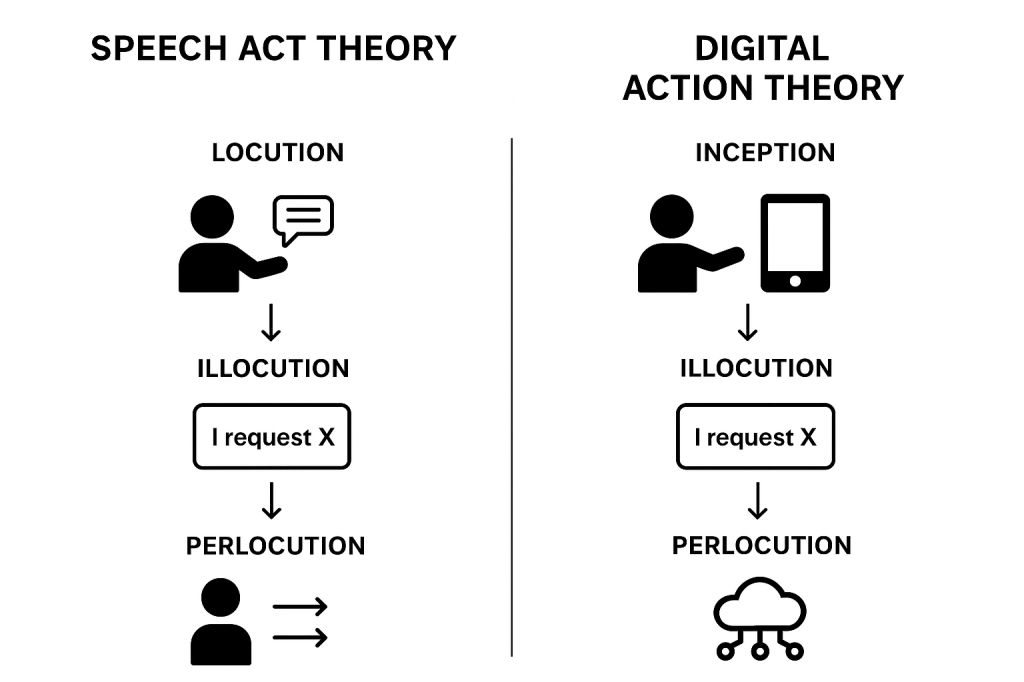
Weaknesses of Tendo Uneni (Speech/Action Theory) in the Digital Context
| Tenet of Tendo Uneni | Weakness in Digital Space |
|---|---|
| Intention / Purpose | Intent is often ambiguous online; digital actions can be misinterpreted, delayed, or amplified beyond the actor’s understanding. |
| Execution / Action | Execution assumes physical/observable acts; in digital space, actions can be automated, algorithm-driven, or mediated by platforms. |
| Social Mediation / Interaction | Social validation depends on direct human networks; online, networks are fragmented, anonymous, and ephemeral. |
| Outcome / Effectiveness | Traditional metrics of success (impact on community) are difficult to measure online; virality may not equal meaningful impact. |
| Ethics & Rationality | Ethical frameworks are inconsistent; what is rational in one digital context may be irrational in another. |
Insight: Tendo Uneni is human-centric, local, and linear. Digital space is algorithmic, networked, and exponential. Therefore, applying classical Action Theory directly online is often irrelevant.
2️⃣ Pillars of Digital Action Theory (DAT)
We can now reconstruct a professional framework:
- Digital Intent (DI)
- Recognizes multi-layered intentions, including human and machine-mediated intentions.
- Considers ambiguity, scalability, and platform constraints.
- Example: A tweet may intend humor but also aims for virality; bots may amplify the effect unintentionally.
- Mediated Execution (ME)
- Actions are performed through technology, not purely human hands.
- Execution is algorithmically enabled, not just socially observable.
- Example: Social media campaigns, AI-generated content, scheduled posts.
- Networked Legitimacy (NL)
- Social validation now comes from digital networks, not only personal communities.
- Legitimacy is distributed, anonymous, and fluid, influenced by platform culture and algorithmic visibility.
- Example: A TikTok challenge may gain legitimacy globally without knowing the creator.
- Diffused Outcomes (DO)
- Digital actions create diffused, unpredictable consequences.
- Success is measured not only by intent fulfillment but also network propagation and interaction metrics.
- Example: A viral video can influence global culture even if unintended by the creator.
- Ethics & Digital Rationality (EDR)
- Ethical evaluation must consider platform norms, privacy, AI mediation, and community standards.
- Rationality includes understanding algorithmic biases, automated amplification, and unintended consequences.
- Example: Posting misinformation may be rational for engagement but ethically problematic.
3️⃣ Key Differentiators from Tendo Uneni
| Aspect | Tendo Uneni | Digital Action Theory (DAT) |
|---|---|---|
| Agency | Fully human | Human + technological mediation |
| Social Mediation | Direct human networks | Networked, algorithmically amplified, decentralized |
| Outcome | Predictable, socially measurable | Diffused, viral, often unintended |
| Ethics | Universal, human-centered | Contextual, platform-mediated, decentralized |
| Execution | Linear, observable | Multi-layered, virtual, automated, asynchronous |
Marejeleo ya Kitaaluma
- Austin, J. L. (1962). How to Do Things with Words. Oxford: Clarendon Press.
- Searle, J. R. (1969). Speech Acts: An Essay in the Philosophy of Language. Cambridge: Cambridge University Press.
- Herring, S. C. (2013). Discourse in Web 2.0: Familiar, Reconfigured, and Emergent. Georgetown University Press.
- Crystal, D. (2011). Internet Linguistics: A Student’s Guide. Routledge.
- Johnpaul, A. (2025). Digital Action Theory: Human Agency and Communication in the Age of Technology. Kiswahili Research Series Blog.
 Jifunze Kiswahili na mwalimu Johnpaul Arigumaho